Now Reading: Old Delhi: A Sensory Walking Guide to Markets, Food and History
-
01
Old Delhi: A Sensory Walking Guide to Markets, Food and History
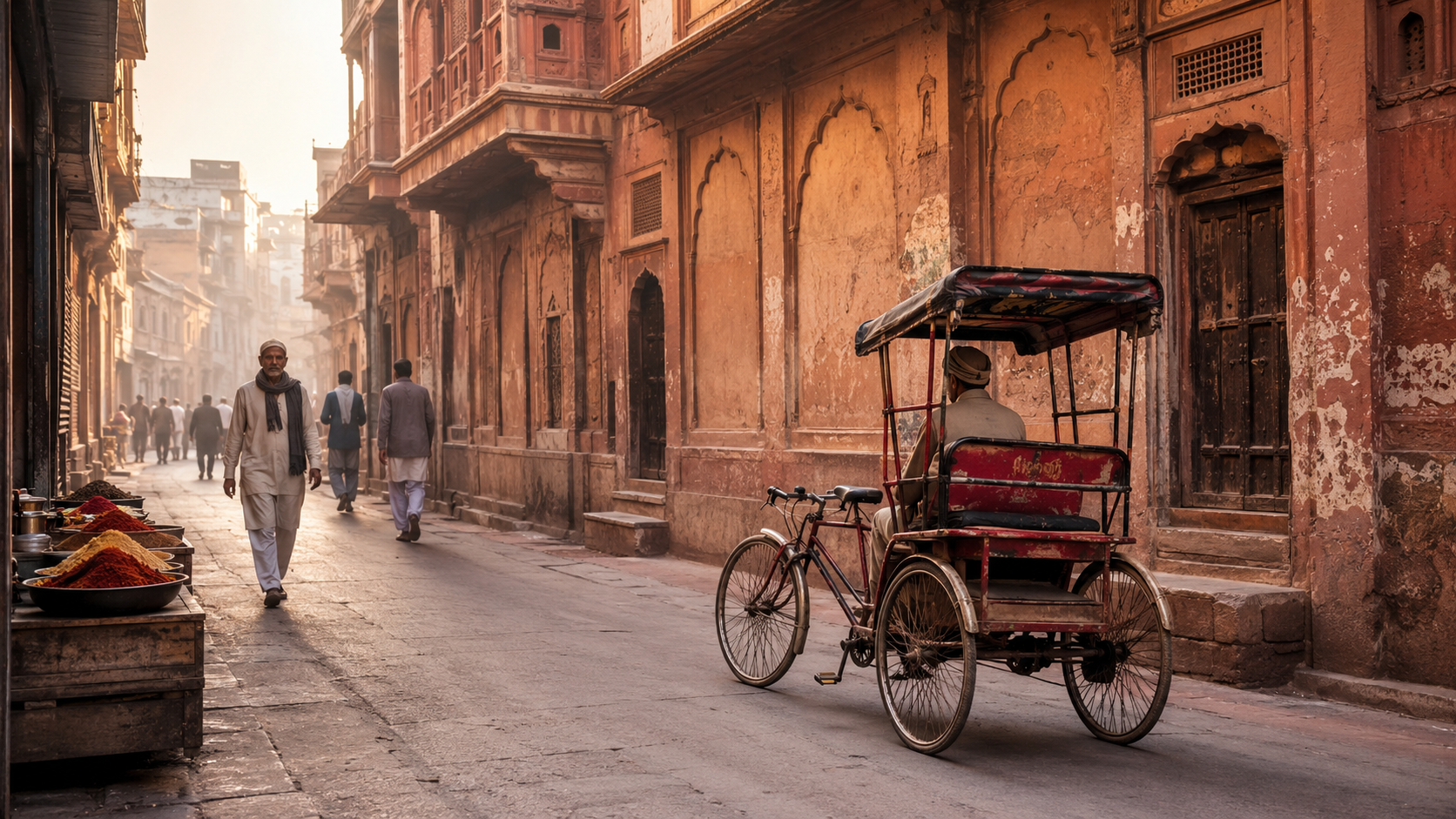

Follow a practical, immersive walk through Old Delhi, from the Red Fort and Chandni Chowk to silver lanes, spice markets, Jama Masjid and the food stalls of Matia Mahal.
Old Delhi does not reveal itself politely. It arrives all at once.
A bicycle bell rings behind you. A porter leans into a handcart stacked higher than his head. Cardamom, hot oil, incense and traffic fumes occupy the same breath. Above the shopfronts, electrical wires sag between old balconies while pigeons circle the red walls of the fort. Somewhere inside the crowd, a cook drops dough into oil and a temple bell answers the call to prayer.
This is not a neighbourhood to observe through a car window. Old Delhi makes sense at walking pace, when its great Mughal avenue breaks into lanes devoted to silver, wedding trims, spices, books, prayer and food. The apparent chaos begins to acquire a pattern. Every turn has a trade, every doorway a story and every few metres something fragrant enough to delay you.
This Old Delhi walking guide follows a practical route from the Red Fort to Chandni Chowk, Khari Baoli, Jama Masjid and Matia Mahal. You can complete the core walk in half a day, but six unhurried hours gives you time to enter places of worship, share several small dishes and occasionally stand still. That last part matters. Old Delhi rewards curiosity, not speed.
Old Delhi walk at a glance
| Best starting point | Lal Quila Metro Station on the Violet Line |
|---|---|
| Finishing point | Jama Masjid Metro Station on the Violet Line |
| Walking distance | About 4 to 5 km, depending on detours |
| Time needed | 5 to 6 hours without a full Red Fort visit; 7 to 8 hours with it |
| Best days | Tuesday to Thursday for the best balance of open markets and manageable crowds |
| Best start time | 8:30 am for breakfast and cooler streets, or 9:30 am if entering the Red Fort |
| Avoid if possible | Sunday, when many wholesale businesses close; Friday midday around Jama Masjid; festival afternoons unless you enjoy very dense crowds |
| Typical food budget | ₹800 to ₹1,800 per person for shared snacks and one meal |
| What to wear | Light, modest clothing and secure shoes that are easy to remove |
A useful route: Lal Quila Metro → Red Fort → Shri Digambar Jain Lal Mandir → Gauri Shankar Temple → Chandni Chowk → Gurudwara Sis Ganj Sahib → Dariba Kalan → Paranthe Wali Gali → Kinari Bazaar and Naughara → Fatehpuri Masjid → Khari Baoli → short e-rickshaw ride → Jama Masjid → Matia Mahal → Jama Masjid Metro.
The route is not a perfect straight line. Old Delhi was not designed for modern sightseeing efficiency, and trying to force it into one usually means missing its best lanes. Walk west from the fort to the spice market, then use an e-rickshaw for the return towards Jama Masjid. Agree the fare before getting in.
Before Chandni Chowk: understanding Shahjahanabad
“Old Delhi” is a convenient modern name. The city you are entering was Shahjahanabad, founded in the seventeenth century when Mughal emperor Shah Jahan moved his capital from Agra. The Red Fort was its palace citadel, Jama Masjid its monumental mosque and Chandni Chowk its ceremonial and commercial spine.
Shah Jahan’s daughter Jahanara is closely associated with the design of Chandni Chowk. The avenue once included a water channel and a pool said to catch the moonlight, which gave the market its name: the moonlit square. The water has gone, the old city walls survive only in fragments and the original mansions have been subdivided, rebuilt or hidden behind signage. Yet the underlying logic remains. The fort anchors one end of the avenue. Fatehpuri Masjid anchors the other. Between them, trade continues in specialised bazaars.
The Mughal story is only one layer. The uprising of 1857, British destruction and rebuilding, the railway, Partition in 1947 and generations of migration have all reshaped the neighbourhood. Its religious landscape is equally layered. Jain, Hindu, Sikh, Christian and Muslim places of worship stand remarkably close together. Old Delhi is not a preserved Mughal stage set. It is a working city carrying several centuries at once.
Stop 1: the Red Fort, the city’s great red threshold
Come up from Lal Quila Metro and the fort seems almost too composed for the streets around it. Its sandstone walls run broad and high, with the Lahori Gate forming the familiar ceremonial entrance. Inside, the surviving pavilions hint at the palace city Shah Jahan imagined, once organised around gardens, courts and a water channel called the Nahr-i-Behisht, or Stream of Paradise.
If the fort is one of the main reasons you came to Delhi, enter when it opens and allow at least 90 minutes. Two hours is better. If markets and food are your priority, admire the walls and Lahori Gate from outside, then continue. A full fort visit followed by every market in this guide can turn a pleasurable walk into an endurance test.
The Red Fort’s routine changed in 2026, so do not rely on older guidebooks that automatically mark Monday as closed. Temporary closures can also happen for state events and security preparations, particularly before Independence Day. Check the official Incredible India Red Fort page and the ASI ticket page shortly before visiting.
Time here: 15 minutes outside, or 90 to 120 minutes inside.
Stop 2: Jain and Hindu Old Delhi beside the fort
Across from the Red Fort stands Shri Digambar Jain Lal Mandir, its red frontage easy to notice but its atmosphere entirely different. Founded in the Mughal period and rebuilt over time, it is often described as Delhi’s oldest Jain temple. Inside, the noise of the main road falls away. Remove shoes and leather items where requested, dress modestly and follow the instructions at the entrance.
The temple complex is also known for its charitable bird hospital. Access arrangements can vary, and visitors should treat it as a functioning care facility rather than an attraction. Keep voices low and never use flash around distressed animals.
A little farther along is Gauri Shankar Temple, one of Chandni Chowk’s important Hindu shrines. Flower sellers cluster nearby, adding marigold, rose and incense to the smell of breakfast frying on the street. Early morning is especially atmospheric, but this is also when worshippers are using the temple most actively. Give them space.
These neighbouring shrines establish the character of the walk. Old Delhi’s sacred places are not isolated monuments. They are woven directly into commerce, traffic and domestic life.
Time here: 25 to 40 minutes for both temples.
Stop 3: Chandni Chowk, where the avenue becomes a current
Step onto Chandni Chowk and let the street set your pace. The central avenue is more pedestrian-friendly than it once was, but “pedestrian” does not mean quiet. E-rickshaws slide through gaps, delivery workers cross with bundles and shoppers stop without warning. Walk predictably, keep valuables zipped and move to the side before checking your phone.
At street level, the shop signs can make the avenue look modern and improvised. Look above them. Old wooden shutters, carved brackets, tiny domes and fading façades survive on the upper floors. A haveli may now contain ten shops, a storeroom and several homes. The city’s history often begins one floor above the merchandise.
Do not try to photograph everything. Choose a tea stall, order a small glass and watch the street. Porters call for space. Shopkeepers unwrap fabric. A scooter somehow emerges from a lane you assumed was too narrow for a person. Ten quiet minutes will teach you more about Chandni Chowk than hurriedly collecting ten similar photographs.
Stop 4: Gurudwara Sis Ganj Sahib
Gurudwara Sis Ganj Sahib stands on the main Chandni Chowk road and commemorates the martyrdom of the ninth Sikh Guru, Guru Tegh Bahadur, who was executed here in 1675 on the orders of Aurangzeb. It is one of the walk’s most historically significant places and, for many visitors, one of its most moving.
Cover your head, remove your shoes and wash your hands or feet where directed. Head coverings are normally available. Sit quietly in the prayer hall for a few minutes instead of simply entering and leaving. If the langar, the community kitchen, is serving, visitors of all backgrounds may usually join. Accept only what you can finish, sit where guided and consider making a discreet donation.
The gurudwara is a place of worship, not a free-food stop. Approached respectfully, it offers something rare in the middle of Chandni Chowk: a feeling of generous stillness without separation from the city outside.
Time here: 20 to 35 minutes.
Stop 5: Dariba Kalan, the silver lane
Turn south from the main road into Dariba Kalan. The lane has long been associated with jewellers, especially silver. Glass counters hold anklets, earrings, chains and ceremonial pieces while workshops deeper inside the buildings continue the less visible work of polishing and repair.
If you are buying precious metal, ask about purity, weight, making charges and whether the shop provides a proper bill. Bargaining is normal in some stores but not all. Compare two or three places and do not let anyone hurry you into a substantial purchase.
Dariba Kalan is also a good lesson in looking beyond a bazaar’s label. Jewellery may dominate, but the lane contains old food businesses, homes, tiny shrines and doorways that lead into still smaller lanes. Stay aware of moving carts and avoid blocking entrances while taking photographs.
Time here: 20 to 30 minutes, longer if shopping.
Stop 6: Paranthe Wali Gali, famous but misunderstood
Paranthe Wali Gali may be Old Delhi’s most famous food lane, which means expectations arrive before the plate does. The parathas here are generally deep-fried rather than cooked lightly on a home griddle. They come with fillings that can range from potato and paneer to peas, lentils, cauliflower, chilli and sweeter combinations, accompanied by chutney, pickles and vegetable preparations.
Think of this as a historic, indulgent tasting rather than Delhi’s definitive everyday paratha. Order one or two varieties to share. Eating a full plate alone can end the food walk before it has properly begun.
The lane is narrow and several establishments use similar claims about age and fame. Choose a busy place preparing food in front of you, ask the price before ordering and pay attention to what looks fresh. You are here for the experience of the lane as much as the food itself: hot oil hissing at the doorway, diners sharing benches and waiters moving plates through spaces that barely seem wide enough.
Try: one savoury paratha shared between two people, with a lassi only if you have plenty of appetite left.
Stop 7: Kinari Bazaar and the quiet surprise of Naughara
Kinari Bazaar is devoted to the details that make Indian celebrations shimmer. Rolls of ribbon, metallic braid, beads, sequins, tassels, borders and wedding decorations crowd the shops. Even if you have no intention of buying, the concentration of colour is extraordinary.
This is a wholesale working market. Stand aside when staff move boxes, ask before photographing inside shops and avoid opening packaged items without invitation. Small purchases are possible, but some businesses prefer larger quantities.
Hidden within the surrounding maze is Naughara, a short row of historic Jain houses known for their colourful façades. The transition can feel improbable. One moment you are inside the metallic glitter of the wedding market; the next, you are in a comparatively calm residential lane. People live here, so keep voices low, photograph façades discreetly and do not treat doorways as props.
Finding Naughara is part of the experience. Mobile maps can become confused inside the lanes. Ask a shopkeeper for “Naughara Jain gali” and confirm the direction again at the next junction. In Old Delhi, navigation is often a conversation.
Time here: 30 to 45 minutes.
Stop 8: Fatehpuri Masjid and the western end of the old avenue
Return to Chandni Chowk and continue west until the road meets Fatehpuri Masjid. Built in the seventeenth century by Fatehpuri Begum, one of Shah Jahan’s wives, the mosque marked the opposite end of the grand market axis from the Red Fort.
Pause here to understand the distance you have covered. The fort may no longer be visible through the urban density, but the relationship between palace, avenue, commerce and worship becomes clearer. Enter only outside prayer times, dress modestly and follow local guidance. Friday midday is not suitable for casual sightseeing.
The mood around Fatehpuri is more mercantile than monumental. Sacks, carts, weighing scales and transport workers signal that you are approaching Khari Baoli. This part of Old Delhi works hard.
Stop 9: Khari Baoli, spice in the air
Khari Baoli is not scented like a carefully arranged spice shop. It is rawer and more physical. Chilli catches the back of your throat. Coriander, turmeric, cumin, dried fruit, tea and nuts appear in sacks and towers. Handcarts squeeze past buyers comparing grades and prices. Dust hangs in shafts of light.
The market is often described with extravagant superlatives. You do not need them. Its scale is obvious from the movement of goods and the concentration of traders. Remember that this is a wholesale district first. Some sellers welcome small purchases; others do not have time for browsing. Ask before handling produce and be clear about quantity and price.
If you have asthma, a chilli sensitivity or respiratory problems, wear a good mask and consider skipping the most enclosed sections. The spice dust makes even regular workers cough. Closed shoes are useful because the ground can be uneven and busy with carts.
Visitors sometimes climb into upper buildings for rooftop views. Do not follow strangers into warehouses or use unsafe staircases simply because a view appears on social media. Enter only where a legitimate business or guide has clear permission, and never interfere with loading work.
Time here: 30 to 45 minutes.
The food trail: what to taste and when
Old Delhi food is easier to enjoy when treated as a sequence of small tastes. Share portions. Alternate fried dishes with something cooling. Save the richest meat dishes for Matia Mahal at the end.
| Food | What to expect | Good moment | Typical 2026 range |
|---|---|---|---|
| Kachori with aloo sabzi | Crisp pastry broken into hot, spiced potato gravy | Breakfast | ₹50 to ₹120 |
| Jalebi | Fermented batter fried into spirals and soaked in syrup | After a savoury breakfast | ₹60 to ₹180 |
| Dahi bhalla or chaat | Lentil dumplings, yoghurt, chutneys and spice, or a crunchy sweet-sour mixture | Late morning | ₹80 to ₹180 |
| Deep-fried paratha | Stuffed bread with chutneys and vegetable sides | Early lunch | ₹100 to ₹250 each |
| Kulfi | Dense Indian frozen dessert, often flavoured with mango, pistachio or saffron | Afternoon | ₹80 to ₹250 |
| Seekh kebab | Spiced minced meat cooked over charcoal | Evening in Matia Mahal | ₹150 to ₹350 |
| Nihari or korma | Slow-cooked, rich meat gravy, best with naan or khameeri roti | Dinner | ₹300 to ₹700 per dish |
Prices vary by portion, reputation and whether you eat standing at a stall or in a restaurant. Famous names are not automatically the best choice on the day. Look for steady local turnover, food cooked in front of you and serving utensils kept away from cash.
A sensible street-food rule
Choose food that is cooked thoroughly and served piping hot. Drink sealed bottled water or safely filtered water, wash or sanitise your hands and avoid cut fruit that has been sitting exposed. Yoghurt and ice are best taken from busy, established businesses with reliable refrigeration.
Cross-contact is common in compact kitchens. Travellers with severe allergies should not depend on a vague verbal assurance in a crowded lane. Carry an allergy card in Hindi, medication prescribed for you and a backup meal from a place that can clearly explain its ingredients.
From Khari Baoli to Jama Masjid
By the time you leave the spice market, your feet will probably be asking for diplomacy. Hire an e-rickshaw towards Jama Masjid rather than retracing the whole avenue. Shared rides are cheaper; a private ride gives you more control over the destination. Show the driver the mosque name on your phone, agree the total price and confirm whether you will be dropped at a particular gate.
If you still have energy, you can walk back through Ballimaran, an area associated with opticians, footwear and the poet Mirza Ghalib. Ghalib ki Haveli is a worthwhile detour for readers interested in Urdu literature, but opening arrangements can change. Adding it usually requires another 45 to 60 minutes.
Stop 10: Jama Masjid, space above the lanes
Jama Masjid rises from Old Delhi on a broad stone platform, reached by a long flight of steps. After hours inside narrow markets, the courtyard feels almost startlingly open. Red sandstone, white marble, arcades and minarets frame a sky that seemed to disappear in Chandni Chowk.
Shah Jahan commissioned the mosque in 1644, and it was completed in 1656. It remains an active place of worship, not merely a historic monument. Remove shoes, dress modestly and use a robe if staff request it. Women can visit. Avoid prayer periods, especially the main Friday congregation, and never walk in front of someone praying.
Delhi Tourism currently lists different visitor arrangements for Indian and foreign tourists, including a foreign visitor fee. These policies can change, so check the official Jama Masjid visitor information before your walk. If you plan to climb a minaret, ask whether it is open that day and assess the narrow staircase honestly. It is not comfortable for everyone.
Sit at the edge of the courtyard for a while. The great reward is not ticking off another monument. It is looking back towards the dense city and recognising the route you have just walked.
Time here: 30 to 50 minutes, excluding prayer closures.
Stop 11: Matia Mahal after dark
Leave Jama Masjid towards Matia Mahal and Old Delhi changes flavour again. Grills smoke at shopfronts. Skewers line up over charcoal. Bakers pull breads from tandoors. Restaurant signs compete with sweet shops and fruit carts, and the crowd thickens towards dinner.
This is the place for kebabs, chicken, korma, nihari and breads such as khameeri roti. Karim’s is the historic name most visitors know, while Al Jawahar and numerous smaller businesses have loyal followings of their own. Reputation in Old Delhi is a lively argument. Choose according to what you can see, smell, afford and comfortably eat, not because a single social-media list declared a winner.
A good meal for two might be one kebab, one gravy dish, breads and something sweet. Rich Mughlai food becomes tiring when ordered as a checklist. During Ramadan, the area is especially atmospheric after sunset but also exceptionally crowded, and business hours shift around fasting and prayer.
For dessert, look for kulfi, shahi tukda or phirni. Then walk to Jama Masjid Metro rather than attempting another cross-city road journey by car from inside the market.
How much does an Old Delhi walk cost?
| Item | Budget estimate per person |
|---|---|
| Metro journeys within central Delhi | ₹40 to ₹120 |
| Shared snacks through the day | ₹400 to ₹900 |
| Final meal in Matia Mahal | ₹400 to ₹900 |
| E-rickshaw between Khari Baoli and Jama Masjid | ₹30 to ₹150 depending on shared or private ride and negotiation |
| Temple, gurudwara and mosque donations | Your choice |
| Red Fort and any current monument fees | Check official prices, as Indian and foreign visitor rates differ |
A realistic total is ₹900 to ₹2,000 per person excluding the Red Fort ticket and shopping. Carry small rupee notes. Digital payment by UPI is widespread, but most overseas visitors cannot assume their home banking app will work with every vendor.
Practical advice for walking Old Delhi
Choose the right day
Tuesday, Wednesday and Thursday are the easiest days for this complete route. Many wholesale shops close on Sunday, individual businesses take different weekly days off and Friday prayer affects access around Jama Masjid. Festival periods bring remarkable energy but much heavier crowds.
Use the Metro
Road traffic around Old Delhi is slow and unpredictable. The Metro gives the walk clean start and finish points. Lal Quila and Jama Masjid are on the Violet Line, while Chandni Chowk station is on the Yellow Line. Check the official Delhi Metro map before leaving.
Carry less than you think you need
Bring a small zipped bag, water, tissues, hand sanitiser, sun protection and a good mask for dust, pollution and the spice market. Avoid dangling jewellery and keep your phone away from the road edge. A bulky backpack becomes exhausting in narrow shops and crowded lanes.
Dress for sacred spaces
Cover shoulders and knees. Carry socks if you dislike walking barefoot on hot or cold stone, though some places may require socks to be removed too. A light scarf is useful for head covering. Follow the rules of each site rather than assuming one set of customs applies everywhere.
Ask before photographing people
A market is visually irresistible, but it is also somebody’s workplace and neighbourhood. Ask before taking close portraits, especially of worshippers, children, food preparation and people receiving care or charity. A smile and a simple “Photo?” is often enough. Accept no gracefully.
Expect intense crowds, not constant danger
Old Delhi can feel overwhelming because sound, movement and proximity are unfamiliar. Most visits are trouble-free, but petty theft and opportunistic overcharging are possible. Zip valuables, separate cash, agree transport fares and do not follow unsolicited “guides” into private buildings. If a lane becomes uncomfortably congested, step into an open shop or return to the main road.
Solo women and families
Women travel through these markets every day, but first-time solo visitors may feel more comfortable in daylight and on the main route. Dress modestly, use the Metro, avoid deserted upper floors and trust your instinct about unwanted attention. Families should hold younger children closely. Pushchairs are difficult in side lanes, and a child carrier may be more practical for toddlers.
Accessibility
The renovated main Chandni Chowk avenue is easier than many side lanes, but the complete route is not step-free. Uneven surfaces, congestion, high kerbs, mosque steps and narrow entrances create barriers. Travellers with limited mobility may get more from a shorter main-road route with a pre-arranged accessible vehicle between major stops. Confirm access directly with each religious site and monument.
A shorter three-hour Old Delhi route
If you have only a morning, do not attempt the entire guide. Start at Lal Quila Metro, see the Red Fort from outside, visit the Jain and Hindu temples, walk Chandni Chowk, pause at Gurudwara Sis Ganj Sahib, explore Dariba Kalan and Paranthe Wali Gali, then finish at Chandni Chowk Metro.
This shorter route keeps the essential mixture of faith, commerce, history and food without adding the spice market and Jama Masjid. If Islamic architecture and Mughlai food matter more to you, reverse the priorities: begin at Jama Masjid, eat around Matia Mahal, walk through Dariba Kalan and finish at the Red Fort.
Should you take a guide?
You can follow this route independently, especially if you are comfortable with busy cities. A knowledgeable local guide adds value by explaining the social history of individual lanes, obtaining legitimate access to private heritage spaces and managing food portions. They are most helpful when interpretation matters more to you than simply finding landmarks.
Choose guides who name their route, group size, inclusions and food policy clearly. Ask whether vendors receive commissions and whether rooftop access is authorised. Avoid anyone who approaches aggressively outside a monument and tries to redirect you to a “government” shop.
Frequently asked questions
Is Old Delhi walkable?
Yes, and walking is the best way to experience it. The difficulty comes from crowd density, heat, uneven side lanes and constant stopping rather than distance. Combine walking with one short e-rickshaw ride.
What is the best time to visit Old Delhi?
October to March usually offers the most comfortable temperatures, though winter pollution and fog can be severe. In hotter months, start early and take a long break at midday. During the monsoon, wear shoes with grip and expect puddles.
Is Sunday a good day for Chandni Chowk?
Sunday can be quieter, but many wholesale businesses and famous market lanes close. It is useful for architecture and a less intense introduction, but poor for the complete shopping and spice-market experience.
Can vegetarians enjoy the food walk?
Very easily. Kachori, jalebi, chaat, parathas, lassi and kulfi can fill an entire route. The area immediately around Matia Mahal is more meat-focused, so vegetarian travellers may prefer to eat their main meal in Chandni Chowk.
Do I need cash?
Carry it. Many vendors accept UPI, but overseas cards and international mobile-payment setups are not dependable at small stalls. Small notes reduce awkward change and make rickshaw fares easier.
Can I visit all the religious places?
Visitors are generally welcome when sites are open, but access can pause during prayer, ceremonies or security checks. Dress modestly, remove shoes where required, cover your head at the gurudwara and follow instructions without argument.
Old Delhi is not a checklist
By evening, the route may blur into fragments: silver glinting under fluorescent light, chilli in your throat, bare feet on cool stone, hot jalebi syrup sticking to a paper plate, a pigeon lifting from the mosque courtyard and vanishing over the roofs.
That is how Old Delhi stays with you. Not as one monument or one famous meal, but as an accumulation of lives compressed into lanes that have repeatedly changed without losing their purpose. People still come here to pray, bargain, repair, carry, cook, celebrate and begin again the next morning.
Walk slowly. Eat selectively. Ask questions. Look above the shop signs. And when the city becomes too loud, step aside with a cup of tea and let it move around you.
Practical information and price ranges were reviewed in August 2026. Opening times, entry policies, security closures and food prices can change, so confirm important details on official websites shortly before your visit.