Now Reading: Sundarbans Travel Guide: Exploring India’s Mangrove Wilderness
-
01
Sundarbans Travel Guide: Exploring India’s Mangrove Wilderness
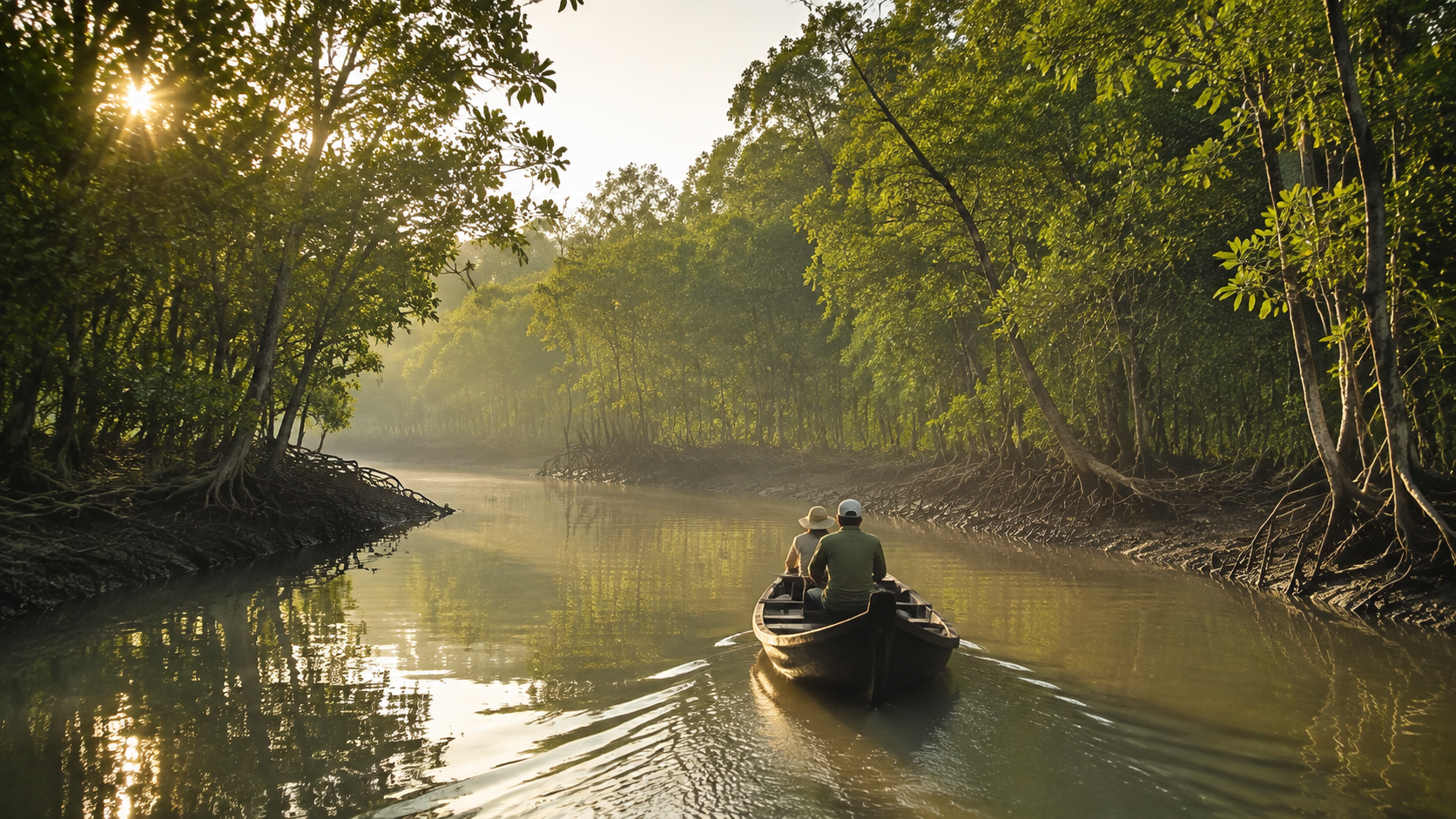

Plan a Sundarbans boat safari from Kolkata with this practical guide to the best time, routes, stays, wildlife, costs and a realistic 3-day itinerary.
The forest does not announce itself with a grand entrance. It arrives slowly.
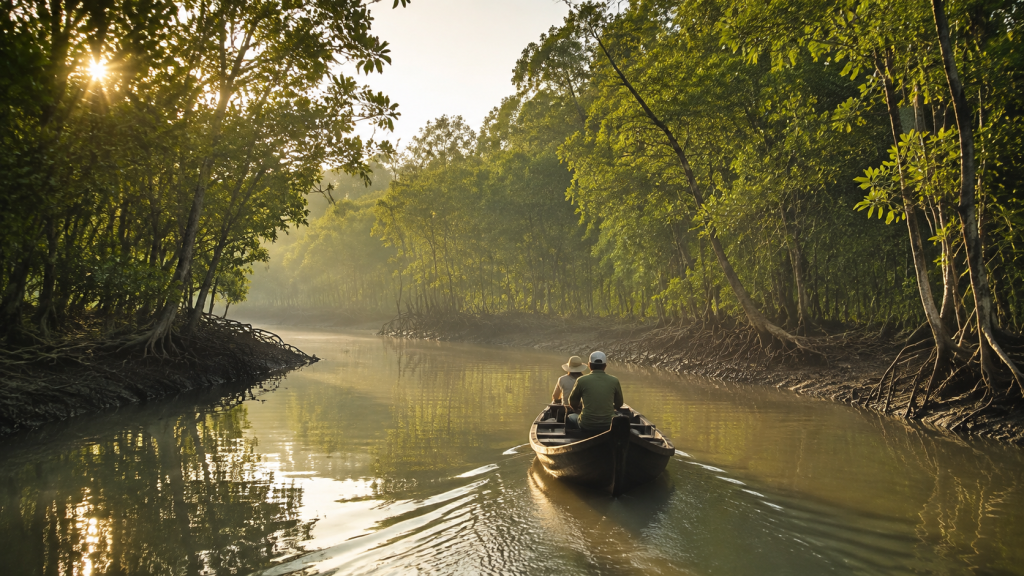
The road from Kolkata flattens into rice fields, ponds and palm-fringed villages. At the jetty, the land begins to loosen its grip. You step onto a boat, the engine settles into a low rhythm, and the river widens until the horizon seems to be made of water and green.
Then the mangroves close in. Their roots rise through the mud like hundreds of small breathing straws. A kingfisher flashes blue between the branches. Somewhere beyond the bank, hidden by leaves and tide, a spotted deer gives an alarm call. Every eye on the boat turns towards the same patch of forest.
This is the Indian Sundarbans, a vast tidal wilderness on the southern edge of West Bengal. It is home to Royal Bengal tigers, saltwater crocodiles, dolphins, monitor lizards and an astonishing variety of birds. Yet the Sundarbans is not a conventional tiger park. There are no jeeps, no dusty forest tracks and no reliable tiger sightings. Here, the journey itself is the safari.
This Sundarbans travel guide explains how to reach the forest from Kolkata, when to go, where to stay, what a boat safari is really like and how to plan a rewarding two-night, three-day visit.
Sundarbans at a glance
| Location | South 24 Parganas, West Bengal, India |
|---|---|
| Nearest major city | Kolkata |
| Main boarding points | Godkhali and Dhamakhali, depending on your operator and route |
| Best time to visit | October to February |
| Ideal trip length | 2 nights and 3 days |
| Safari type | Boat safari only |
| Best for | Slow travel, birdwatching, wildlife, landscapes, village life and photography |
| Do not expect | A guaranteed tiger sighting or a fast-paced checklist holiday |
What makes the Sundarbans so extraordinary?
The Sundarbans stretches across India and Bangladesh at the mouth of the Ganges, Brahmaputra and Meghna river system. Together, its land and waterways cover about 10,000 square kilometres and contain the world’s largest area of mangrove forest. India’s Sundarbans National Park was added to the UNESCO World Heritage List in 1987.
Numbers explain the scale, but they do not fully explain the feeling of being here. The landscape is never still. Twice each day, the tide floods and reveals the muddy edges of the islands. River channels change width. Sand and silt move. Tree roots hold the banks together while salty water pushes deep into the delta.
Even the wildlife has adapted to this liquid world. The Sundarbans tiger is a powerful swimmer. Spotted deer feed near the waterline. Mudskippers wriggle across exposed banks. Fiddler crabs lift their oversized claws from the mud. Estuarine crocodiles rest so quietly that a fallen branch can suddenly appear to have eyes.
The human story matters just as much. Millions of people live in and around the wider delta, in communities shaped by fishing, farming, honey collection, cyclones, erosion and the daily calculation of the tide. Hindus and Muslims alike honour Bonbibi, the guardian spirit of the forest, before entering a landscape that can provide a living and take one away.
A Sundarbans safari is not like other Indian safaris
The most important thing to understand before booking is that you will not enter the Sundarbans in a jeep. Licensed motorboats travel along rivers and permitted creeks, and visitors get off only at designated watchtowers and tourism camps.
Much of the wildlife is seen from the water. You may spot deer through a gap in the mangroves, a crocodile on a mudbank, macaques in the canopy or dolphins breaking the surface beside the boat. Birdlife can be constant, especially in winter. Tigers are present, but they remain remarkably difficult to see in dense tidal forest.
A good guide looks for clues rather than promising miracles: fresh pugmarks in the mud, a sudden chorus of monkey calls, deer staring into the trees or birds lifting from a quiet bank. The tension of not knowing what is behind the next bend is part of the Sundarbans experience.
If seeing a tiger is your only measure of success, you may leave disappointed. If you come for the mangroves, river light, birds, local stories and the rare possibility of a tiger, the forest can stay with you for years.
Best time to visit the Sundarbans
October to February: the best overall season
These are the most comfortable months for a Sundarbans trip. Days are generally pleasant, humidity is lower and the rivers are usually calmer. Migratory birds add life to mudflats and creeks, while crocodiles and monitor lizards are more likely to bask when the sun is gentle.
December and January bring the coolest weather and the highest demand. Book early if you want a particular lodge or a smaller boat over Christmas, New Year or a winter weekend.
March to May: hot, humid and quieter
Temperatures climb and the midday heat can feel heavy on an exposed boat deck. Wildlife still moves through the forest, but long hours on the river are more tiring. The reward is fewer visitors, vivid skies and a slower atmosphere. Carry sun protection, electrolytes and more drinking water than you think you will need.
June to September: monsoon beauty with real uncertainty
The monsoon turns the delta intensely green, but this is not the easiest season for a first visit. Rain can be prolonged, rivers rougher and storms may disrupt road and boat travel. Protected-area tourism can also be suspended temporarily for weather, wildlife management or administrative reasons.
Some resorts continue to operate in inhabited islands, but that does not guarantee access to the tiger reserve. Confirm the forest status and cancellation terms directly before travelling in the monsoon. Never rely on a social media post or an old package itinerary.
How many days do you need?
A day trip is possible, but it is a long day dominated by the journey from Kolkata. You may spend almost as much time on roads as you do inside the mangrove landscape.
One night gives you a better sense of the delta, especially if your boat safari begins early on the second morning. The most satisfying first visit is usually two nights and three days. It allows one full day on the water, time for a village walk and enough flexibility for tides, weather and watchtower routes.
Four days can work well for birdwatchers, photographers and travellers who enjoy moving slowly. Longer routes towards Burirdabri, Jhingekhali or other eastern sections may require more time and are always subject to current permissions.
How to reach the Sundarbans from Kolkata
Kolkata is the practical gateway. The protected forest is reached by a combination of road or rail and boat. Your exact boarding point should come from your accommodation or tour operator because the route depends on where you are staying.
The easiest route: pre-arranged transfer
Most first-time visitors book a package or lodge transfer from Kolkata. A shared car or minibus usually leaves early, drives through the southern outskirts and rural South 24 Parganas, and reaches Godkhali or another designated jetty in roughly three to four hours, depending on traffic.
At the jetty, you transfer to a registered boat for the final river journey. Resorts around Pakhiralay, Dayapur, Sajnekhali and Bali Island have different transfer arrangements, so do not assume every booking begins at the same ghat.
The independent route: train to Canning
Budget travellers can take a suburban train from Sealdah to Canning. From Canning, continue by bus, shared vehicle or reserved car towards Godkhali or the boarding point specified by your host. From there, a public ferry or pre-arranged boat connects to the inhabited islands.
This route is cheaper but involves several changes, busy stations and informal local transport. It is manageable with light luggage and daylight, but much less enjoyable after dark or with young children. Arrange the final boat connection in advance rather than arriving at a jetty and hoping to negotiate entry into the reserve.
Can you drive all the way?
You can drive only as far as a mainland jetty such as Godkhali. Private parking is available there, according to the Sundarban Tiger Reserve’s travel guidance. Beyond the jetty, the journey continues by water.
Permits, registered boats and guides
Tourists may enter the Sundarban Tiger Reserve only on registered boats. Boats travelling inside the reserve must carry an authorised ecotourism guide. In practice, a reputable lodge or tour operator normally arranges the boat, guide, entry permissions and applicable fees as part of the package.
Before paying, ask for written confirmation that the quoted price includes:
- a registered boat and licensed guide;
- forest entry and watchtower fees;
- camera charges, if applicable;
- transfers between Kolkata, the jetty and your accommodation;
- meals and drinking water;
- all taxes and boat fuel; and
- life jackets for every passenger.
The reserve’s current “How to Reach” page states that foreign visitors do not need a separate special permit. Another older page on the same official website still carries conflicting wording. Foreign nationals should therefore send a passport copy only through their confirmed operator’s secure process, carry the original passport and reconfirm the rule shortly before travel.
Do not book a boat that is willing to enter protected waters without the required registration or guide. Apart from being illegal, it removes the safeguards that make tourism here possible.
Where to stay in the Sundarbans
There is no single town called “Sundarbans” where every traveller stays. Accommodation is spread across inhabited islands and forest-edge settlements. Common bases include Pakhiralay, Dayapur, Bali Island and the Sajnekhali area.
The right base depends less on luxury labels and more on logistics. Ask how long it takes to reach the first permitted creek in the morning. A beautiful resort with a long daily transfer can mean fewer quiet hours inside the forest.
Budget lodges and homestays
Simple rooms can be excellent value and bring more of your spending into the local economy. Expect basic furnishings, local meals and occasional power or mobile-network interruptions. Ask about attached bathrooms, mosquito nets, backup electricity and hot water before booking.
Mid-range eco-resorts
These usually bundle accommodation, meals, transfers and a shared boat safari. The word “eco” is used freely, so look beyond the name. Useful signs include local staff, filtered-water stations, waste separation, refillable toiletries, solar power and small safari groups.
Private and higher-comfort stays
More comfortable resorts offer air-conditioned rooms, landscaped grounds and private transfers. The extra cost can be worthwhile for families, older travellers or anyone sensitive to heat. Confirm whether the forest safari itself is private. A premium room does not always include a private boat.
The main places to visit
No itinerary should promise every watchtower. Tides, route permissions, distance and the forest department’s instructions determine what can be visited on a particular day.
Sajnekhali
Sajnekhali is one of the main visitor hubs and a common permit stop. It has a mangrove interpretation centre, a watchtower and ponds associated with turtle and crocodile conservation. It is a useful introduction to the ecology of the reserve, although it can become busy when several boats arrive together.
Sudhanyakhali
This watchtower overlooks a freshwater pond and open strips within the mangroves. Spotted deer, wild boar and other animals may come towards the water. It is also one of the places where visitors quietly hope for a tiger to appear, but patience is more reliable than expectation.
Dobanki
Dobanki is known for its elevated, fenced canopy walk. The walkway offers a different view of the forest and its tangled root systems, with a watchtower at the end. It is one of the most memorable stops on a standard multi-day route.
Burirdabri
Farther east, Burirdabri combines a protected trail, mudflat views and a watchtower looking towards the Raimangal River and the international boundary with Bangladesh. Reaching it requires time, favourable conditions and the appropriate route permissions, so it is more likely to feature in a longer itinerary.
Netidhopani and Jhingekhali
Netidhopani has a watchtower and the remains of an old temple, while Jhingekhali offers another freshwater-pond observation area. Access can vary. Treat both as possibilities to discuss with a knowledgeable operator rather than guaranteed boxes to tick.
Gosaba and the inhabited islands
The Sundarbans is not only protected forest. Gosaba’s markets, village paths, ponds, embankments and homes reveal how life is organised in a delta where roads end at water. A thoughtful village walk can add meaning to the safari, provided it is led respectfully and does not turn residents into exhibits.
Wildlife you may see
The Royal Bengal tiger receives most of the attention, but the Sundarbans becomes much richer when you look beyond one animal.
- Spotted deer: Often seen feeding along forest edges or gathering near freshwater.
- Estuarine crocodiles: Look for them basking on exposed mudbanks, particularly in cooler weather.
- Irrawaddy and Ganges river dolphins: Sightings are brief, often just a curved back or sudden breath beside the boat.
- Wild boar and rhesus macaques: Both are regularly encountered around the mangrove margins.
- Water monitor lizards: Large reptiles that move between mud, roots and water with surprising ease.
- Birds: Brahminy kites, white-bellied sea eagles, egrets, herons, cormorants, waders and several species of kingfisher reward patient watching.
- Mudflat life: Mudskippers, fiddler crabs and horseshoe crabs reveal the smaller world on which the whole ecosystem depends.
A realistic 3-day Sundarbans itinerary
Day 1: Kolkata to the delta
Leave Kolkata early and travel to your assigned jetty. Board the boat and let the pace change. The river crossing may take one to two hours depending on your island base.
After lunch and check-in, take a gentle village walk. Notice the raised embankments, fish ponds, kitchen gardens and small shrines to Bonbibi. If your route and arrival time allow, visit Sajnekhali or take a short sunset cruise. End the day with a Bengali dinner, perhaps rice, dal, vegetables and fresh fish.
Day 2: full-day boat safari
Start around sunrise. Cool morning air sits above the water and the first hour often brings the best bird activity. After completing the required formalities, enter the permitted tourism zone with your guide.
A typical route may include Sudhanyakhali and Dobanki, with hours of slow cruising between them. Breakfast and lunch are commonly served on board. Keep binoculars ready, but spend time looking without a camera too. Mangrove wildlife often appears for seconds, not minutes.
Return before evening. The final stretch can be beautiful as fishing boats cross the orange light and smoke rises from village kitchens.
Day 3: one last river journey and return to Kolkata
Take a short morning cruise, visit a nearby interpretation point or enjoy an unhurried breakfast beside the water. Then travel by boat to the mainland jetty and continue to Kolkata.
Keep the evening free. Road traffic, tides and boat transfers make an exact arrival time difficult to guarantee, so avoid booking a same-evening flight or long-distance train.
How much does a Sundarbans trip cost?
Package prices vary widely according to group size, room standard, starting point and whether the boat is shared or private. The following are realistic planning ranges checked in August 2026, not fixed tariffs. US dollar conversions use a rounded rate of ₹95 to US$1.
| Trip style | Typical price per person | Approx. USD |
|---|---|---|
| Shared day trip from Canning or Godkhali | ₹1,500 to ₹3,000 | US$16 to US$32 |
| Shared 1-night, 2-day budget trip | ₹2,500 to ₹6,000 | US$26 to US$63 |
| Shared 2-night, 3-day standard trip | ₹4,000 to ₹9,500 | US$42 to US$100 |
| Private or higher-comfort 2-night, 3-day trip | ₹12,000 to ₹25,000+ | US$126 to US$263+ |
Very low advertised prices may begin at Canning rather than Kolkata, assume three or four people sharing one room, exclude forest fees or use a large shared boat. Ask for the total price and inclusions before paying a deposit.
What to eat
Meals are usually simple, generous and strongly Bengali. Expect steamed rice, dal, seasonal vegetables, fried aubergine, chutney and fish curry. Depending on season and budget, meals may include bhetki, prawns, crab or hilsa. Chicken is widely available, and vegetarian food is easy to arrange when requested in advance.
Ask your host what is genuinely local and seasonal rather than ordering an elaborate “Sundarbans feast” built around seafood sourced from elsewhere. Fresh river fish cooked with mustard, chilli and turmeric is often more memorable than a long restaurant menu.
Drink filtered or sealed safe water. The reserve prohibits single-use plastic bottles, so carry a refillable bottle and ask whether your boat provides a water dispenser.
What to pack
- light, breathable clothing in muted colours;
- a warm layer for early winter mornings;
- a sun hat, sunglasses and high-factor sunscreen;
- mosquito repellent and any personal medication;
- binoculars, ideally one pair per traveller;
- a dry bag or waterproof pouch for electronics;
- closed shoes or sandals with a secure grip;
- a refillable water bottle;
- cash in small notes for village purchases and tips;
- passport or government-issued photo identification; and
- motion-sickness tablets if you are sensitive to long boat journeys.
A long telephoto lens is useful, but do not let heavy camera equipment take over the trip. The boat engine vibrates, wildlife is often shaded and the best sightings can happen on the opposite side of the deck.
Safety and responsible travel
The Sundarbans is safe for visitors who travel with registered operators and follow forest rules. It is still a wild, tidal environment, and the rules deserve more than casual attention.
- Wear a life jacket whenever instructed and make sure children have correctly sized jackets.
- Never step onto a riverbank or enter the forest outside an authorised camp.
- Do not swim, fish or trail your hands in the water.
- Keep noise low. Loud music is prohibited inside the reserve.
- Do not smoke or drink alcohol in the forest area.
- Drones are strictly prohibited.
- Do not throw food, plastic or any other waste into the river.
- Never ask a guide or boatman to approach wildlife too closely.
- Follow weather warnings. Cyclones and tidal surges are not occasions for adventurous improvisation.
Responsible travel also means thinking about where your money goes. Choose locally staffed accommodation, hire trained local guides, buy handicrafts directly from community sellers and avoid staged encounters that reduce village life to a photograph.
Travelling with children or older relatives
The Sundarbans can be a wonderful family experience, but a full-day boat safari is long. Boats vary considerably in seating, shade, toilets, railings and deck access. Ask for recent photographs of the actual boat, not a generic image.
For children, bring familiar snacks, sun protection, a small wildlife checklist and a properly fitted life jacket if the operator cannot guarantee one. Older travellers may prefer an air-conditioned room, a private vehicle from Kolkata and a boat with easy boarding and a western-style toilet.
Avoid the hottest months if anyone in the group struggles with heat. Also be realistic about mobility. Jetties can be steep or slippery as the tide changes, and getting between boats sometimes requires careful steps.
Mobile signal, electricity and money
Mobile coverage reaches many inhabited islands but becomes patchy on the water and near the forest. Download tickets, identity documents and maps before leaving Kolkata.
Electricity and backup power vary by property. Charge cameras and power banks overnight. Card payments and UPI may work at established resorts, but network failures are common enough that carrying cash is sensible. ATMs should not be part of your last-minute plan once you leave Canning or the mainland towns.
Common mistakes to avoid
- Booking only for the tiger: A tiger sighting is possible, never guaranteed.
- Choosing the cheapest headline price: Compare the starting point, room sharing, permits, meals and boat size.
- Trying to do it as a rushed day trip: Two nights reveal far more of the landscape.
- Arriving without a registered boat booking: Independent travel to an inhabited island is not the same as authorised entry into the reserve.
- Scheduling a tight onward connection: Tides, traffic and weather can all slow the return.
- Expecting luxury everywhere: The delta is remote, and even good properties can experience weak signals and power interruptions.
- Ignoring the smaller wildlife: The crabs, mudskippers, roots and birds tell the story of the mangroves as clearly as the tiger.
Frequently asked questions
Is the Sundarbans worth visiting if I do not see a tiger?
Yes. The landscape, birdlife, crocodiles, dolphins, village culture and experience of travelling through a living tidal forest make the journey worthwhile. A tiger sighting is an exceptional bonus.
Can I explore the Sundarbans without a tour?
You can travel independently to inhabited islands, but entry into the tiger reserve requires a registered boat and authorised guide. Most visitors arrange these through a lodge or operator.
Is one day enough?
One day offers a glimpse, but the Kolkata journey consumes much of it. Two nights and three days is the best balance for a first visit.
Are there jeep safaris?
No. Wildlife tourism inside the Sundarbans is conducted by registered boat or launch.
Which side should I visit, India or Bangladesh?
This guide covers the Indian Sundarbans in West Bengal. The Bangladesh Sundarbans is a separate destination with its own visas, permits, ports and operating seasons. You cannot casually cross the international boundary during a safari.
Do foreign visitors need a special permit?
The current official “How to Reach” guidance says no separate special permit is required for foreigners, but another older official page contains conflicting information. Carry your passport and ask your registered operator to confirm the latest procedure before departure.
Is the Sundarbans open all year?
Accommodation on inhabited islands may operate throughout the year, but access to protected tourism zones can be suspended because of storms, monsoon conditions or forest-management decisions. Always verify current access before a summer or monsoon trip.
The Sundarbans rewards patience
There may be a moment when the boat engine falls quiet and everyone listens. Mangrove leaves tremble in the heat. A deer watches from the bank. The guide points towards marks in the mud, fresh enough to make the river feel suddenly smaller.
Perhaps the tiger has already crossed the creek. Perhaps it is lying a few metres inside the green wall, invisible and untroubled by your arrival. You will probably never know.
That uncertainty is not a failure of the Sundarbans. It is the reason the forest still feels wild. Come with time, humility and attention, and India’s mangrove wilderness offers something rarer than a guaranteed sighting: the sense that the landscape is living on its own terms.
Practical details and prices were checked in August 2026. Forest access, fees and permitted routes can change at short notice. Confirm the latest arrangements with the Sundarban Tiger Reserve or your registered operator before travelling.