Now Reading: The Perfect Three-Day Delhi Itinerary
-
01
The Perfect Three-Day Delhi Itinerary

Follow this perfect three-day Delhi itinerary through Old Delhi, Mughal monuments, markets, gardens and South Delhi, with practical routes, food ideas and realistic costs.
Delhi does not reveal itself in a neat sequence. It arrives as the scent of cardamom drifting through a crowded lane, the cool shadow of a Mughal arch, the call to prayer floating above Old Delhi and the sudden calm of a garden where parakeets flash between ancient tombs.
Three days will not show you every version of the city. Nothing could. But three well-planned days are enough to experience its essential contrasts without spending the entire trip trapped in traffic or racing from one monument to another.
This perfect three-day Delhi itinerary begins among the mosques, markets and red sandstone walls of Shahjahanabad. It then moves through the garden tombs and ceremonial avenues of New Delhi before finishing among the older ruins, creative neighbourhoods and evening food stalls of South Delhi.
In a hurry? Spend day one in Old Delhi, day two around Humayun’s Tomb, Lodhi Garden, India Gate and Connaught Place, and day three at Qutub Minar, Mehrauli, the Lotus Temple and Dilli Haat. Start early, use the Metro for longer journeys and keep short auto-rickshaw or cab rides for the gaps between stations and sights.
Three days in Delhi at a glance
| Day | Area | Main experiences | Ideal finish |
|---|---|---|---|
| Day 1 | Old Delhi | Jama Masjid, Red Fort, Chandni Chowk, Gurudwara Sis Ganj and Khari Baoli | Old Delhi rooftop or Connaught Place |
| Day 2 | Mughal and New Delhi | Humayun’s Tomb, Lodhi Garden, India Gate, Kartavya Path and Gurudwara Bangla Sahib | Connaught Place |
| Day 3 | South Delhi | Qutub Minar, Mehrauli Archaeological Park, Lotus Temple and Dilli Haat | Dinner at Dilli Haat |
The plan deliberately limits each day to one part of the city. Delhi is enormous, and a route that looks short on a map can become slow once heat, traffic and security queues are involved.
Before beginning your Delhi itinerary
Where to stay
For a first visit, Connaught Place and the surrounding central districts make the most convenient base. You will have useful Metro connections, plenty of places to eat and reasonable access to all three days of this itinerary.
Paharganj, beside New Delhi Railway Station, has abundant budget accommodation and backpacker energy, but it can feel intense immediately after a long flight. South Delhi is calmer and often more comfortable, although journeys to Old Delhi will be longer.
If this is your first journey in the country, our India travel guide covers the practical decisions that are easier to make before arrival.
How to get around
The Delhi Metro is usually the fastest way to cross the city. The official Delhi Metro Rail Corporation website provides a network map and journey planner. DMRC currently lists a three-day Tourist Smart Card at ₹500, including a refundable ₹50 security deposit. It offers unlimited travel on the regular Metro network but does not cover the Airport Express Line. Prices and conditions can change, so confirm them at the station.
Metro alone will not carry you to every doorway. Use a short auto-rickshaw or app-based cab ride when the final walk is inconvenient. In Old Delhi, a cycle-rickshaw can be part transport and part experience. Agree the fare and destination before setting off.
How to arrange the days
The itinerary works in the order shown, but it is flexible. The Lotus Temple is closed on Mondays. If your third day falls on a Monday, replace it with the Garden of Five Senses, Safdarjung’s Tomb or more time among Mehrauli’s ruins.
The Red Fort, once routinely closed on Mondays, began opening seven days a week in February 2026. Temporary security closures are still possible, particularly around major national events, so check the official Archaeological Survey of India ticket portal shortly before your visit. At Jama Masjid, non-Muslim visitors should avoid Friday’s midday prayer period.
Day 1: Old Delhi, where the city overwhelms the senses
Old Delhi is not the place to begin cautiously. It pulls you straight into the story. Rickshaw bells ring through the lanes, vendors call from beneath tangled electrical wires, oil crackles in breakfast shops and the red walls of the Mughal city rise beyond the traffic.
8:00am: Begin at Jama Masjid
Arrive while the stone courtyard is still relatively cool. From the broad steps of Jama Masjid, the roofs and lanes of Shahjahanabad spread below you in a dense, restless patchwork. Inside, red sandstone and white marble frame a space that can feel surprisingly still despite the market streets outside.
Dress modestly, remove your shoes and follow local instructions. Coverings are normally available when required. The Delhi Tourism visitor page currently lists tourist access from 8:00am until sunset for foreign visitors and a ₹400 charge. Access pauses around prayers, and arrangements can change.
Afterwards, stop for breakfast in the lanes near the mosque. Depending on your appetite, that might be a plate of chole bhature, bedmi puri with spiced potato, or a gentler start of chai, bread and an omelette. Choose somewhere busy, order food cooked fresh and hot, and save your adventurous appetite for what feels comfortable rather than trying everything at once.
9:30am: Walk through the Red Fort
Continue towards the Red Fort, the great palace-fortress from which Shah Jahan ruled his new Mughal capital. Beyond the Lahore Gate, the noise of the road falls away. Arched pavilions, gardens and audience halls offer glimpses of an imperial world that was once decorated with far greater richness than the surviving stone suggests.
Allow around two hours. The complex is large, exposed to the sun and more rewarding when you slow down enough to notice carved screens, water channels and the changing view between the buildings. Foreign visitor admission is generally around ₹550 when booked online, with a higher price possible for tickets that include museums. Use the official ASI portal for the live choice and price.
12:00pm: Follow Chandni Chowk on foot
Leave the fort and enter Chandni Chowk, once the ceremonial heart of the Mughal capital and still one of Delhi’s great commercial streets. The main avenue is only the beginning. Its side lanes specialise in jewellery, wedding fabrics, paper, spices, sweets and household goods, each trade seeming to occupy its own miniature world.
Pause at Gurudwara Sis Ganj Sahib, a Sikh place of worship associated with the martyrdom of Guru Tegh Bahadur. Cover your head, leave your shoes in the designated area and wash your hands before entering. The polished interior and rhythm of devotional music create a profound change of pace from the street outside.
If you are invited to see the community kitchen, observe respectfully. Sikh langar is based on equality and hospitality, with volunteers preparing and serving free meals to visitors regardless of background. A donation or a little time helping is welcome but never demanded.
1:30pm: Eat lunch in the old city
Old Delhi deserves a proper lunch rather than a hurried snack. Around Jama Masjid, Mughlai kitchens serve kebabs, rich curries and breads pulled hot from the tandoor. Elsewhere, vegetarian shops specialise in parathas, chaat, kachori and sweets shining with syrup.
Karim’s is the famous historic name near Jama Masjid, but fame also brings queues and mixed expectations. Treat it as one option rather than an obligation. A smaller, busy restaurant with a short menu can be just as memorable.
3:00pm: Smell the spices at Khari Baoli
Continue west towards Fatehpuri Masjid and Khari Baoli. Sacks of dried chillies, coriander, tea, nuts and turmeric spill colour into the narrow lanes. Porters move astonishing loads through gaps that barely seem wide enough for one person.
The market is atmospheric but functional, not staged for tourists. Keep out of workers’ paths, ask before photographing people and expect chilli dust to catch at the back of your throat. If you have asthma or are sensitive to dust, enjoy the surrounding lanes and skip the most enclosed spice sections.
5:00pm: Slow the evening down
By late afternoon, you may have absorbed enough sound, colour and human movement for one day. Settle on a reputable rooftop for tea and a final view across the old city, or take the Metro back to Connaught Place for an easier dinner.
If you still have energy, Raj Ghat is a calm optional addition. The simple memorial to Mahatma Gandhi lies southeast of the Red Fort, but adding it will require a short ride and will make the day longer.
Day 2: Garden tombs and the grand avenues of New Delhi
The second day feels spacious after Old Delhi. It begins beneath the Persian-influenced dome of Humayun’s Tomb, moves through gardens where Delhi residents walk beneath medieval monuments, and ends among the ceremonial architecture of the modern capital.
7:30am: See Humayun’s Tomb in the morning light
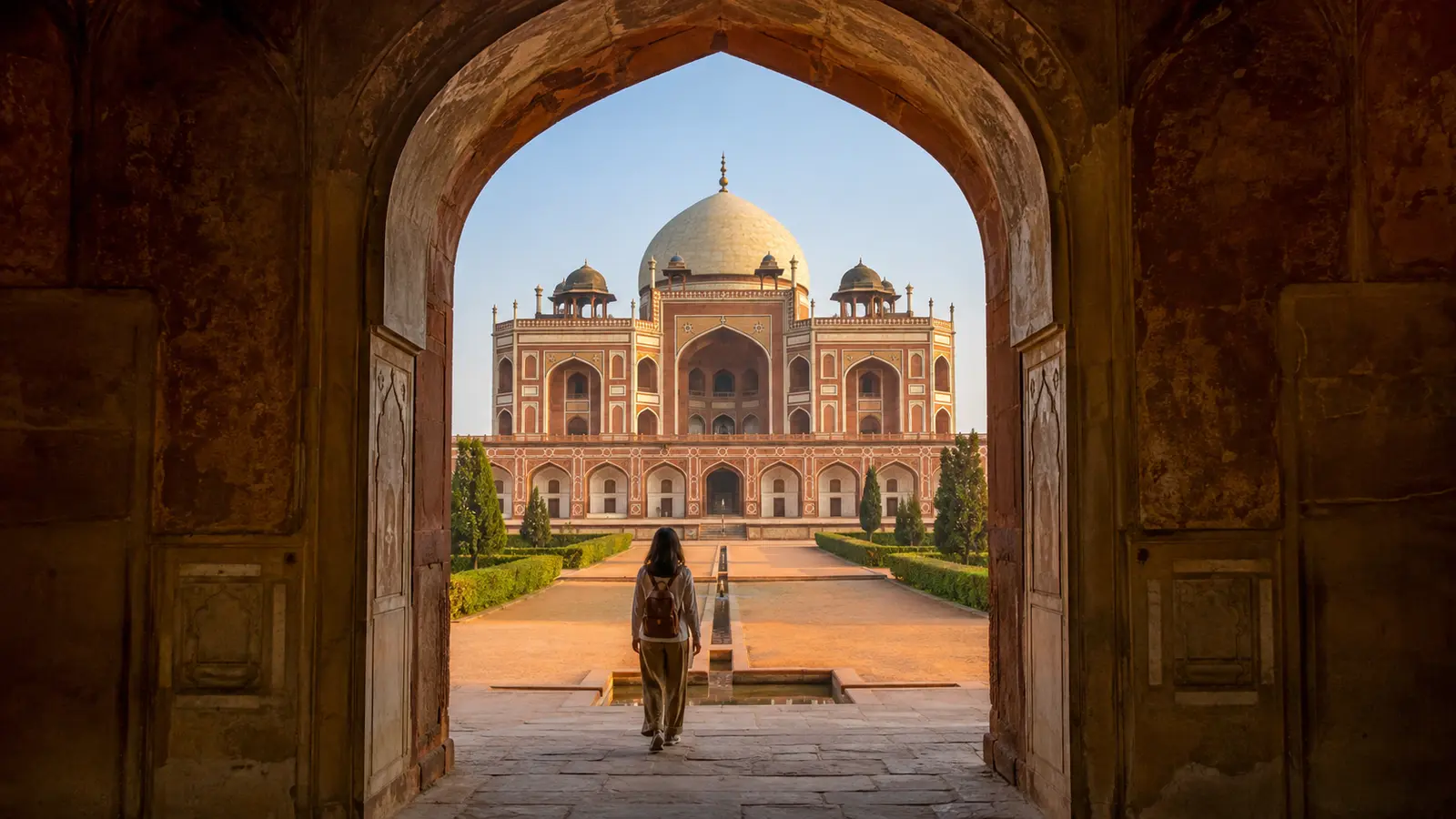
Arrive near opening time, when the pathways are quieter and the first light warms the red sandstone. Humayun’s Tomb was commissioned in the sixteenth century by the emperor’s widow, Bega Begum. Its charbagh garden, high platform and balanced geometry helped establish an architectural language later brought to its most famous expression at the Taj Mahal.
Do not hurry directly to the central dome. Walk through the gateways, notice the smaller tombs around the complex and look back as the monument repeatedly frames itself through arches. The official Delhi Tourism page lists the site as open daily from sunrise, with online foreign visitor admission around ₹550.
10:00am: Walk beneath the trees at Lodhi Garden
A short cab or auto ride brings you to Lodhi Garden. Here, fifteenth and sixteenth-century tombs stand among lawns, palms and old trees used by joggers, families and courting couples. The pleasure lies in how casually the city lives around its history.
Walk between the domed tomb of Muhammad Shah, the Bara Gumbad complex and Sikandar Lodi’s walled garden. Entry is free, and an unhurried hour is enough unless you want to linger with a book beneath the trees.
12:00pm: Lunch around Khan Market or Lodhi Colony
Khan Market has polished cafés, bakeries and restaurants, while nearby Lodhi Colony offers a more neighbourhood-like pause and colourful public murals. This is a useful moment to choose lighter food after the richness of Old Delhi, although you will find everything from North Indian cooking to South Indian dosas and modern café plates.
2:00pm: Follow Kartavya Path to India Gate
Travel towards the centre of ceremonial New Delhi. The long axis of Kartavya Path runs between Rashtrapati Bhavan and India Gate, bordered by lawns, government buildings and broad open sky. The scale is deliberate, designed to communicate power first under the British Raj and later reinterpreted as part of independent India’s capital.
India Gate is free and accessible throughout the day. Walk beyond the arch to the National War Memorial, where concentric landscaped circles commemorate members of India’s armed forces. Late afternoon is more comfortable than midday, and the stone becomes warmer in colour as the sun drops.
Optional interior visit: Travellers with a strong interest in government and architecture can pre-book Rashtrapati Bhavan instead. The official visitor portal currently lists the Main Building as open from Tuesday to Sunday, with timed entry and advance booking required. Replace the leisurely lunch or part of the garden walk rather than attempting to squeeze it into an already full afternoon.
5:00pm: Experience the calm of Gurudwara Bangla Sahib
As traffic builds, enter the white marble complex of Gurudwara Bangla Sahib. Devotional singing carries through the prayer hall, while the golden dome reflects in the sarovar outside. The atmosphere is welcoming, but this remains an active place of worship rather than a sightseeing set.
Cover your head, remove shoes and dress respectfully. Walk around the pool without entering the water, and ask before photographing worshippers. If you visit the langar hall, sit where directed and receive only as much food as you can finish.
6:30pm: End in Connaught Place
Finish beneath the white colonnades of Connaught Place. The circular streets hold restaurants, cafés, bookshops and old institutions among international chains. For a more local final bite, walk towards Bengali Market for chaat and sweets, or seek out a dependable North Indian restaurant for dinner.
Day 3: Qutub Minar, Mehrauli and South Delhi
Delhi is often described as a city of cities, built, abandoned and rebuilt by successive dynasties. The final day makes that history tangible. Around Mehrauli, centuries sit close together: early Sultanate architecture, stepwells, Mughal tombs, colonial additions and modern neighbourhoods.
7:30am: Arrive early at Qutub Minar
Qutub Minar rises above the trees before the rest of the complex comes into view. Its bands of red sandstone, carved inscriptions and changing balconies draw your eyes upward, but the surrounding ruins deserve equal attention.
Walk through the Quwwat-ul-Islam Mosque, study the Iron Pillar and stand beneath the Alai Darwaza, where geometry and stone carving reward a closer look. The unfinished mass of Alai Minar nearby is a reminder that Delhi’s grandest ambitions were not always completed.
The official visitor information lists opening from sunrise into the evening. Foreign visitor admission is generally ₹550 online or ₹600 at the counter, while children aged up to 15 enter free. Early morning gives you softer light, lower temperatures and more space.
9:30am: Explore Mehrauli beyond the minaret
Next door, Mehrauli Archaeological Park spreads through woodland and uneven paths. The park is less polished than Delhi’s headline monuments, which is part of its appeal. Jamali Kamali Mosque and Tomb, Rajon ki Baoli and the remains around Metcalfe’s estate reveal layers of history that a single dynasty cannot contain.
Allow ninety minutes to two hours and wear shoes suitable for broken ground. A knowledgeable local guide adds real value here because the remains are scattered and lightly interpreted. If travelling alone, stay on active routes, visit in daylight and use a current map rather than wandering into isolated sections.
12:30pm: Pause in Hauz Khas
Ride north to Hauz Khas for lunch. The village lanes contain cafés, small shops and restaurants beside the remains of a medieval reservoir and madrasa complex. It is more fashionable and commercially polished than Mehrauli, but the contrast gives you another glimpse of how contemporary Delhi gathers around its past.
2:30pm: Sit in silence at the Lotus Temple
Continue southeast to the Lotus Temple, a Bahá’í House of Worship formed from white marble petals. Visitors of all faiths are welcome to enter, sit quietly and pray or reflect. After three days of traffic and crowded monuments, the silence inside can be the detail you remember most clearly.
Entry is free. The Delhi Tourism page currently lists opening from 9:00am to 5:30pm, Tuesday to Sunday, with Monday closed. Queues form before the prayer hall, so leave enough time and do not arrive close to the final admission.
5:00pm: Eat your way around India at Dilli Haat
Take the Metro or a cab to Dilli Haat INA for an easy final evening. Designed like a permanent craft market, it brings together rotating artisans and food stalls representing different Indian states. It is tourist-friendly, but still useful for seeing how dramatically textiles, craft traditions and regional cooking change across the country.
Walk once around the market before choosing dinner. You might find momos from the Northeast, kahwa and kebabs from Kashmir, Gujarati snacks, Rajasthani thalis or coastal dishes that feel far removed from Delhi’s own food. It is a fitting conclusion to a capital that contains fragments of the whole country.
Delhi Tourism currently lists Dilli Haat INA as open daily from 11:00am to 8:00pm, with foreign visitor entry at ₹100. Confirm the closing time on the day, as seasonal or event arrangements can vary.
What will three days in Delhi cost?
The following is a realistic planning estimate for one international traveller following this itinerary. It excludes accommodation and shopping. The US dollar conversions use a rounded rate of ₹95 to US$1, close to the exchange rate on 3 August 2026. Exchange rates and entrance fees will change.
| Expense | Three-day estimate | Approximate USD |
|---|---|---|
| Major monuments and listed visitor charges | ₹2,150–₹2,700 | US$23–US$28 |
| Metro, autos and occasional cabs | ₹800–₹1,800 | US$8–US$19 |
| Meals, chai and drinking water | ₹2,400–₹4,500 | US$25–US$47 |
| Estimated total, excluding hotel | ₹5,350–₹9,000 | US$56–US$95 |
Indian citizens and visitors covered by SAARC or BIMSTEC ticket categories usually pay substantially less at ASI monuments. Always select the correct nationality category when booking.
Practical tips that make this Delhi itinerary easier
- Start before the city becomes hot. Morning light improves the monuments, and you will complete the most exposed walking before the afternoon heat.
- Carry small notes. Digital payment is widespread, but cash remains useful for rickshaws, shoe storage donations, water and small food purchases.
- Use official ticket channels. Buy monument tickets through ASI or an authorised counter. Ignore unsolicited claims that a site, hotel or ticket office is closed.
- Dress for sacred spaces. Keep shoulders and knees covered, remove shoes where requested and carry a light scarf that can serve as a head covering.
- Protect yourself from sun and poor air. Carry water, sunscreen and a hat. Check the local air-quality reading, particularly in the cooler months, and consider a well-fitting particulate mask if conditions are poor.
- Do not overschedule evenings. Delhi’s traffic and sensory intensity can be tiring. A quiet meal and an early night may improve the following day more than another attraction.
- Build in security time. Major monuments inspect bags. Travel lightly and avoid carrying anything that may be refused at the entrance.
If you have less or more time
With only one day: Choose Old Delhi in the morning, Humayun’s Tomb in the afternoon and India Gate near sunset. It will be full but still gives you three distinct faces of Delhi.
With two days: Follow days one and two. Qutub Minar is exceptional, but Old Delhi and the Humayun’s Tomb to India Gate route create the most balanced first encounter.
With a fourth day: Visit the National Museum or National Gallery of Modern Art, explore Sunder Nursery, see Akshardham, or take a slower neighbourhood day around Lodhi Colony and Nizamuddin. Check weekly closures before deciding.
Continuing beyond Delhi: The city is a natural starting point for Agra, Jaipur, Rajasthan, Uttarakhand and the wider north. Use our India itineraries to build a longer route, and our North India travel guide to understand how the regions fit together.
Is three days enough for Delhi?
Three days are enough for a rich first encounter, not a complete understanding. You will see the Mughal city, the planned capital and the archaeological landscape of the south. You will also have time to eat properly, sit in a place of worship and notice ordinary Delhi life between the famous sights.
The secret is accepting that the perfect Delhi itinerary is not the one with the longest checklist. It is the one that leaves room for the city itself: the unexpected procession blocking a lane, the extra cup of chai, the conversation in a market and the moment evening light turns red sandstone almost luminous.
Frequently asked questions
What is the best area to stay for three days in Delhi?
Connaught Place is the most convenient central base for a first visit because it has strong Metro connections and straightforward access to Old, New and South Delhi. Budget travellers may prefer Paharganj, while South Delhi offers a calmer atmosphere.
Can I follow this Delhi itinerary using public transport?
Yes. The Metro handles most long journeys, but short auto-rickshaw or cab rides make connections between stations and attractions easier. Old Delhi is best explored mostly on foot, with an optional cycle-rickshaw ride.
Which day should not be a Monday?
Day three is the least suitable for Monday because the Lotus Temple is closed. The Red Fort began opening on Mondays in 2026, although temporary closures can still happen. Always recheck official pages shortly before visiting.
Is Old Delhi safe to explore independently?
Many travellers explore it independently during the day. Expect heavy crowds, guard your phone and wallet, use official transport or agree rickshaw fares in advance, and avoid isolated lanes after dark. A reputable walking guide can make the history and food easier to understand.
When is the best time of year for this itinerary?
October to March usually brings more comfortable walking temperatures, but winter can also bring fog and severe air pollution. April to June can be extremely hot, while the monsoon brings humidity and sudden heavy rain. Whatever the month, early starts make the itinerary easier.
Visitor information and indicative prices were checked in August 2026. Monument hours, ticket charges, prayer access and security closures can change without much notice. Confirm key details through ASI, Delhi Tourism and DMRC before setting out.