Now Reading: The Perfect Two-Week Rajasthan Itinerary
-
01
The Perfect Two-Week Rajasthan Itinerary

A carefully paced 14-day journey through Rajasthan's pink palaces, sacred lake, golden desert, blue lanes and romantic lake city, with realistic travel times and room to breathe.
Rajasthan does not reveal itself in a hurry.
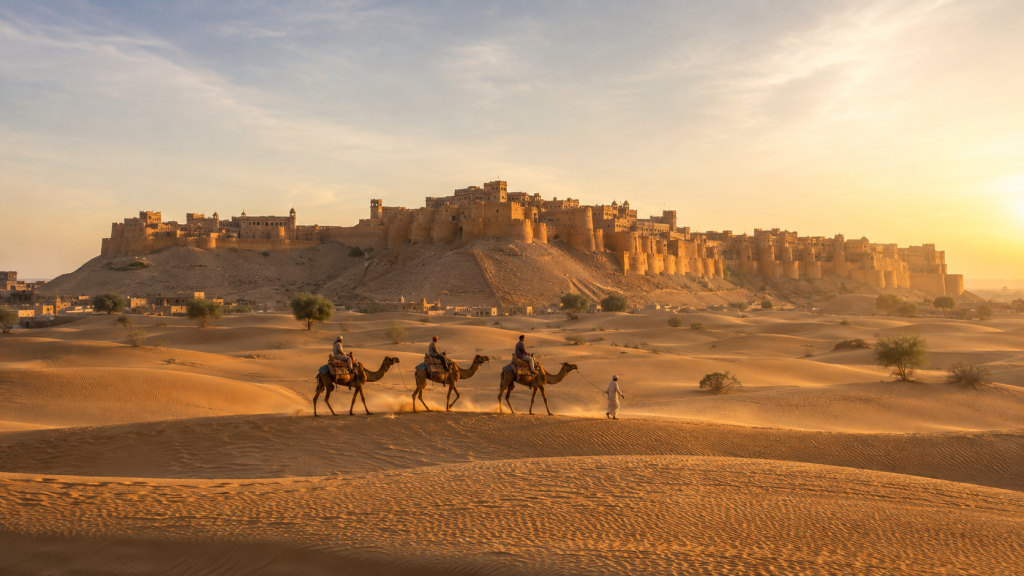
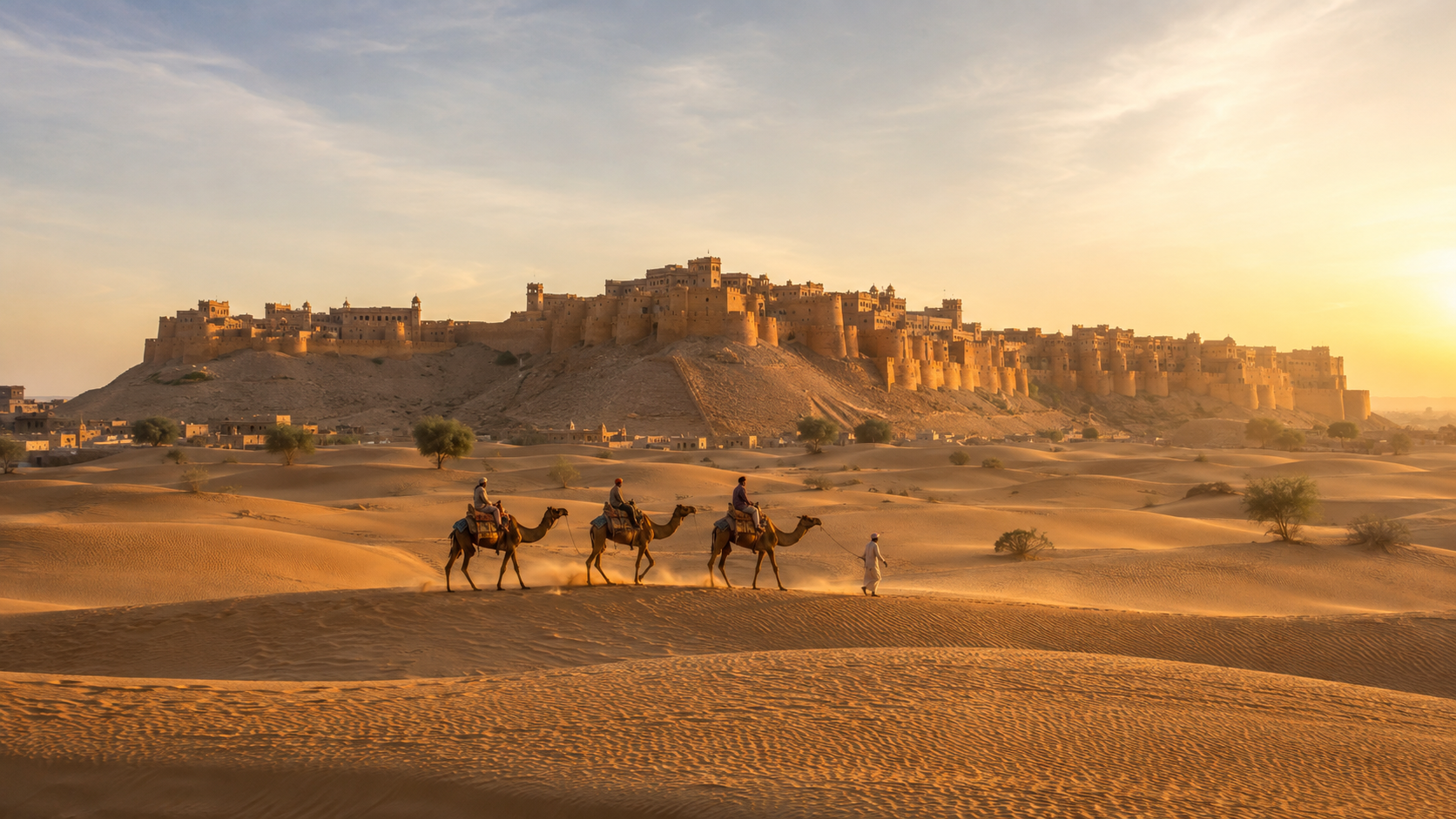
One morning begins with sunlight filtering through the honeycombed windows of Jaipur’s Hawa Mahal. A few days later, temple bells drift across the ghats of Pushkar. Then the landscape opens into the Thar Desert, Jaisalmer glows like carved gold, and Mehrangarh Fort rises above the blue lanes of Jodhpur. By the end of the journey, the pace softens beside the lakes of Udaipur.
Two weeks gives you enough time to experience all of this without treating Rajasthan as a collection of monuments to be ticked off. This route covers the state’s most rewarding first-time destinations, but it also protects a few slow mornings and quiet evenings. Those unplanned hours often become the part you remember most.
The route is:
Jaipur → Pushkar → Jaisalmer → Jodhpur → Udaipur
It works particularly well because you travel steadily west from Jaipur, then turn south from Jodhpur towards Udaipur. An overnight journey between Ajmer and Jaisalmer saves a hotel night and avoids losing a full day to the longest transfer.
Two-Week Rajasthan Itinerary at a Glance
| Day | Destination | Main experience | Overnight |
|---|---|---|---|
| 1 | Jaipur | Arrive, settle in and explore a local market | Jaipur |
| 2 | Jaipur | Amber Palace, Jaigarh or Nahargarh, and Jal Mahal | Jaipur |
| 3 | Jaipur | Hawa Mahal, City Palace, Jantar Mantar and bazaars | Jaipur |
| 4 | Jaipur to Pushkar | Sacred lake, ghats and sunset | Pushkar |
| 5 | Pushkar to Jaisalmer | Savitri Temple, slow afternoon and overnight journey | Train or sleeper bus |
| 6 | Jaisalmer | Arrive, rest, Gadisar Lake and golden-hour walk | Jaisalmer |
| 7 | Jaisalmer | Living fort, Jain temples and sandstone havelis | Jaisalmer |
| 8 | Thar Desert | Desert village, dunes, sunset and camp | Desert camp |
| 9 | Jaisalmer to Jodhpur | Return from the desert and travel to the Blue City | Jodhpur |
| 10 | Jodhpur | Mehrangarh Fort, Jaswant Thada and old city | Jodhpur |
| 11 | Jodhpur to Udaipur | Road journey via Ranakpur Jain Temple | Udaipur |
| 12 | Udaipur | City Palace, old city and Lake Pichola | Udaipur |
| 13 | Udaipur | Markets, Fateh Sagar Lake and a slow final evening | Udaipur |
| 14 | Udaipur | Breakfast, last walk and departure | Departure |
This plan includes 13 nights and assumes you arrive in Jaipur on Day 1 and leave from Udaipur on Day 14. If your international flights use Delhi, add a night before and after the Rajasthan portion rather than squeezing Delhi into these 14 days.
Why This Is the Best Route for a First Rajasthan Trip
Rajasthan is India’s largest state by area, and its famous cities sit much farther apart than they appear on a map. Trying to add Bikaner, Bundi, Chittorgarh, Ranthambore and Mount Abu to a two-week trip usually creates an itinerary dominated by roads and railway platforms.
This route chooses five places that feel genuinely different:
- Jaipur introduces Rajasthan through monumental forts, royal palaces and busy bazaars.
- Pushkar offers a smaller, slower town built around a sacred lake.
- Jaisalmer brings honey-coloured architecture and the open landscapes of the Thar Desert.
- Jodhpur combines one of India’s great forts with a dense, lived-in old city.
- Udaipur closes the journey gently with lakes, hills, courtyards and rooftop evenings.
Three nights in Jaipur and Udaipur allow you to unpack properly. Jaisalmer receives two city nights plus one night in the desert. Pushkar is compact enough for one night and most of the following day, while two nights in Jodhpur give Mehrangarh Fort the time it deserves.
Day 1: Arrive in Jaipur and Ease Into Rajasthan
Jaipur can feel gloriously intense when you first arrive. Scooters slide between auto-rickshaws, market stalls spill colour onto the pavements, and sandstone facades appear between tangles of traffic. Do not plan a major sightseeing list for your first afternoon.
Check in, rest, and take a gentle orientation walk. MI Road and C-Scheme are convenient areas for first-time visitors who want restaurants and easy transport. Staying inside or close to the old walled city places you nearer the bazaars, but it can be noisier and more crowded.
If you still have energy, browse Bapu Bazaar or Johari Bazaar without treating the visit as a shopping mission. Pause for chai, watch the evening traffic gather, and let the city introduce itself.
A good first evening: Choose a rooftop with a view over the old city, order a simple Rajasthani meal, and return to your hotel early. Jaipur deserves your attention tomorrow.
Day 2: Amber Palace and Jaipur’s Hill Forts
Leave early for Amber, around 8 kilometres north of central Jaipur. Amber Palace is one of Rajasthan’s defining sights, a vast complex of gates, audience halls, mirrored chambers and courtyards rising above Maota Lake.
Arriving near opening time brings cooler air, gentler light and fewer groups in the narrow passages. Walk up, take an authorised vehicle, or use the available shuttle arrangements. Skip elephant rides. You lose nothing from the experience, and it is the kinder choice for the animals.
Allow at least two to three hours inside. The Sheesh Mahal, with its tiny mirrored details, is beautiful, but the quieter pleasure is looking back through arches towards the dry Aravalli hills.
After Amber, choose one of the following rather than rushing through both:
- Jaigarh Fort for military architecture, wide views and a stronger sense of the ridge above Amber.
- Nahargarh Fort for a broader view over Jaipur, particularly later in the day.
Pause beside Jal Mahal on the return journey. The palace sits in Man Sagar Lake and is mainly viewed from the promenade. You do not need more than 20 or 30 minutes here.
Spend the evening resting or exploring a neighbourhood restaurant. Fort days involve more steps and sun than expected.
Day 3: Jaipur’s Pink City, Palaces and Bazaars
Begin outside Hawa Mahal while the morning light reaches its pink facade. The Palace of Winds was built with rows of screened windows that allowed royal women to observe life in the street. From close up, the structure feels surprisingly delicate against the noise below.
Continue to the City Palace, where painted gates, textiles, arms and royal courtyards help connect Jaipur’s architecture with the people who built and inhabited it. Beside the palace, Jantar Mantar turns astronomy into stone. Its enormous geometric instruments are far more interesting with a guide or a good audio explanation.
Keep the afternoon loose. Walk through the old city’s bazaars, look for block-printed textiles, lac bangles, blue pottery and handmade leather goods, and stop whenever the heat or traffic becomes tiring.
If you are buying jewellery or expensive crafts, compare several shops and request written details about materials. Jaipur shopping should feel enjoyable, not pressured.
Do not miss: A glass of lassi or a plate of hot kachori, followed later by a proper Rajasthani thali. Try dal baati churma, gatte ki sabzi, ker sangri and bajra roti across the trip rather than ordering everything at once.
Day 4: Jaipur to Pushkar
After breakfast, travel from Jaipur to Pushkar. The road journey usually takes around 2.5 to 3.5 hours depending on traffic and stops. Public buses are inexpensive, while a private car gives you an easier door-to-door journey. Rail travellers normally go to Ajmer and continue to Pushkar by local taxi or bus.
Pushkar changes the mood of the trip immediately. Whitewashed buildings gather around a sacred lake, temple bells carry through narrow lanes, and the town is compact enough to explore on foot.
Check in and walk towards Pushkar Lake. Remove your shoes where required, dress respectfully and avoid photographing people bathing or conducting rituals. You may be approached by someone offering flowers or a blessing and later requesting a large donation. If you want to participate, agree on any amount clearly beforehand. A polite, firm refusal is also acceptable.
Visit the Brahma Temple, then wander without a strict route. Pushkar’s lanes are full of small cafes, clothing shops and guesthouses, but the ghats remain the heart of the town.
Finish the day at a lakeside viewpoint or on a rooftop as the light softens over the surrounding hills.
Day 5: Pushkar Sunrise and an Overnight Journey to Jaisalmer
Wake early for Savitri Mata Temple. You can walk up the hill or use the ropeway when it is operating. From the top, Pushkar Lake appears as a pale circle surrounded by low buildings, farmland and dry hills.
Return for breakfast and leave most of the day unstructured. This pause is deliberate. Have a slow lunch, browse the market, sit with a book or revisit the lake when the midday groups have moved on.
In the evening, transfer to Ajmer Junction for an overnight train towards Jaisalmer, subject to the current timetable and availability. Pushkar to Ajmer station generally takes 30 to 45 minutes by road, but allow extra time for traffic. A reserved air-conditioned sleeper is worth booking for comfort.
If the train does not suit your dates, use a reputable sleeper bus or travel by private car during the day. Schedules change, so confirm the exact service before reserving non-refundable accommodation.
Day 6: Arrive in the Golden City
After the overnight journey, keep your first day in Jaisalmer deliberately light. Arrange an early check-in or at least luggage storage, shower, eat and rest.
In the late afternoon, walk around Gadisar Lake, where shrines and sandstone gateways reflect in the water. Continue through the streets below Jaisalmer Fort as the stone begins to glow in the lowering sun.
The fort is extraordinary, but consider staying outside its walls. Jaisalmer is a living fort with homes, temples, shops and guesthouses still operating inside. Its hill has long been vulnerable to water seepage and infrastructure pressure. Visiting the businesses inside supports residents, while sleeping outside can reduce some of the demand placed on its fragile systems.
Choose a rooftop for sunset and watch the fort change from pale yellow to deep honey. This is the evening to do very little.
Day 7: Jaisalmer Fort, Jain Temples and Havelis
Enter Jaisalmer Fort early, before the lanes become busy. Unlike many forts in Rajasthan, this one still functions as a neighbourhood. Children leave for school, deliveries squeeze through old gateways, worshippers enter temples, and daily life continues beneath carved balconies.
Visit the palace complex and the cluster of Jain temples, observing clothing, photography and leather-item rules displayed at the entrances. Move slowly through the lanes and remember that many beautiful doorways are private homes, not exhibits.
After lunch, explore the great merchant houses below the fort:
- Patwon Ki Haveli, an elaborate group of carved sandstone residences
- Nathmal Ki Haveli, known for its detailed facade
- Salim Singh Ki Haveli, distinguished by its projecting upper storey
You do not need to enter every haveli. Choose one or two, then spend time noticing the stonework from the street. The pleasure of Jaisalmer lies as much in its surfaces, shadows and narrow lanes as in formal sightseeing.
Use the evening to confirm tomorrow’s desert pickup, inclusions and return time.
Day 8: Into the Thar Desert
Most desert trips leave Jaisalmer after lunch, often stopping at a village, temple or the abandoned settlement of Kuldhara before continuing to the dunes.
You will usually choose between two broad areas:
- Sam Sand Dunes have the largest selection of camps, performances and activities. They are convenient and lively, but popular sunset areas can become crowded.
- Khuri and smaller dune areas often feel quieter and simpler, although the experience depends greatly on the operator and exact camp location.
Ask where the camp is located, how many guests it hosts, whether amplified music continues late, and whether the quoted price includes transport, meals and activities. Photographs of an empty dune do not always show the reality of a large camp beside a busy access road.
If you take a camel ride, look at the animal before agreeing. Avoid camels with visible wounds, poor body condition or overloaded saddles. Shorter rides, rest breaks and operators who can explain how their animals are cared for are better signs. A walk across the dunes or a quiet jeep transfer is a perfectly valid alternative.
As sunset approaches, the heat drains from the sand and long shadows gather along the ridges. Stay for the stars if the sky is clear. In winter, desert nights can become surprisingly cold, so keep a fleece or light insulated jacket in your day bag.
Day 9: Jaisalmer to Jodhpur
Return to Jaisalmer after breakfast and continue to Jodhpur. The two cities are around 285 kilometres apart, and the road journey commonly takes 5 to 6 hours. Trains and buses also connect them, although timings may shape most of your day.
This is primarily a transfer day. Check in, shower and head towards the Clock Tower and Sardar Market if you arrive before evening. The market is at its best when you are not chasing a list. Smell the spices, watch vendors measure grains and look up as Mehrangarh Fort darkens above the city.
Stay near the old city for atmosphere and fort views, or choose Ratanada for easier vehicle access and a quieter night.
Day 10: Mehrangarh Fort and the Blue City
Mehrangarh is the great anchor of Jodhpur. It rises directly from a rocky ridge, so closely matched to the stone beneath it that the walls can look like part of the hill.
Arrive near opening time and give the fort at least three hours. Its gates, galleries, palanquins, miniature paintings and royal rooms are impressive, but the transition between enclosed chambers and enormous views over the blue houses is what makes the visit memorable.
Walk or take a short ride to Jaswant Thada, a calm marble memorial set beside a small lake. Its pale stone and garden feel almost weightless after the mass of the fort.
Later, explore the lanes around Navchokiya with a local guide if possible. The famous blue houses are part of a real residential neighbourhood. Keep voices low, ask before photographing people and do not block doorways in pursuit of a picture.
End near the Clock Tower with a makhaniya lassi, mirchi bada or a relaxed dinner overlooking the fort.
Day 11: Jodhpur to Udaipur via Ranakpur
Hire a car and driver for the journey from Jodhpur to Udaipur, stopping at Ranakpur Jain Temple. A direct trip can take around five hours, but with the temple, lunch and road conditions, treat this as a full travel day of roughly seven to eight hours.
Ranakpur’s principal temple is a forest of pale marble, with 1,444 intricately carved pillars supporting halls and domes. No photograph quite prepares you for the shifting light inside.
This is an active place of worship. Wear clothing that covers shoulders and knees, follow the rules on food, leather items and photography, and check the current visitor hours before leaving Jodhpur. Temple access arrangements can change around worship and religious events.
Continue through the Aravalli landscape to Udaipur. After checking in, take a short walk through the old city or eat on a rooftop overlooking Lake Pichola. The contrast with the desert is immediate. Water, wooded hills and pale palaces now fill the horizon.
Day 12: Udaipur’s City Palace and Lake Pichola
Start at the City Palace when it opens. The complex rises above Lake Pichola in layers of courtyards, balconies, corridors and decorated rooms. It is easy to spend three hours here, especially when groups slow movement through the narrower sections.
Walk down through the old city to Jagdish Temple, then stop for lunch before the afternoon heat builds. Later, take a boat ride on Lake Pichola if water levels and operations allow. Sunset departures are popular, so reserve ahead during the busiest months.
In the evening, consider the cultural performance at Bagore Ki Haveli or choose a quiet rooftop meal. Confirm current show and ticket arrangements locally rather than relying on an old online timetable.
Udaipur is made for lingering. Leave space between activities and let the lake views do some of the work.
Day 13: A Slower Side of Udaipur
Your final full day should feel spacious. Choose two or three experiences rather than building another sightseeing marathon:
- Walk around Fateh Sagar Lake in the cooler morning air.
- Visit Saheliyon Ki Bari, a garden of fountains, pavilions and lotus pools.
- Browse workshops and small shops selling miniature paintings, textiles and leather journals.
- Join a home-style cooking class and learn the balance behind a few Rajasthani dishes.
- Visit Sajjangarh, the Monsoon Palace, for wide views if visibility is good.
- Sit beside the lake with no plan at all.
For your final dinner, choose somewhere with a view but do not make the view your only criterion. Udaipur has plenty of beautiful terraces serving forgettable food. Recent local recommendations are more useful than a decade-old list.
Day 14: Leave Udaipur
Have breakfast, take one last walk through the old city and leave enough time for the airport or railway station.
Udaipur’s Maharana Pratap Airport is outside the city, so allow for road traffic and airline check-in. Flight routes and frequencies change seasonally. If travelling onwards by train, confirm your station and departure time the day before.
The journey ends here, but Rajasthan rarely feels finished. Two weeks gives you a complete first chapter, not the entire story.
How to Reach the Start and Leave at the End
This itinerary works best as an open-jaw route, arriving in Jaipur and departing from Udaipur.
Jaipur has air and rail connections with major Indian cities. From Delhi, a daytime train is often more comfortable and predictable than a long road transfer. Udaipur has an airport with domestic services as well as rail and road connections. Check current schedules before booking international flights around a tight same-day connection.
If return flights from Udaipur are expensive, reverse the route or travel onwards to Ahmedabad. Avoid returning all the way to Jaipur by road simply to use the same airport unless the saving is substantial.
Getting Around Rajasthan
Trains
Trains are comfortable and good value when their routes match your itinerary. Reserve long-distance sectors as soon as your booking window opens. Indian Railways generally allows advance reservation up to 60 days before travel, excluding the journey date, although some services follow different rules.
For overnight journeys, AC 2-tier offers more space and privacy than AC 3-tier, while AC 3-tier is usually the better-value choice. Keep your passport details consistent with the booking and carry a light sleep layer.
Buses
Government and private buses connect Rajasthan’s main cities. They are useful when the railway route is indirect, but vehicle quality varies. For sleeper buses, check the boarding point carefully because it may be outside the historic centre.
Car and Driver
A car with a driver is the easiest option for couples, families and small groups. It is particularly useful from Jodhpur to Udaipur via Ranakpur. Agree in writing on the daily rate, kilometre allowance, tolls, parking, driver accommodation and overnight charges.
Self-driving is possible, but it is rarely the most relaxing choice for a first visit. Urban traffic, animals, night driving and unfamiliar road behaviour add unnecessary strain.
Local Transport
Auto-rickshaws and app-based cars are widely useful in cities, though coverage varies. Ask your accommodation for a realistic fare, confirm whether the price is per ride or per person, and agree before starting when no meter is used.
What Will Two Weeks in Rajasthan Cost?
These estimates are per person for 14 days, based on two people sharing a room. They exclude international flights, shopping, alcohol and travel insurance. Exchange-rate conversions use approximate August 2026 mid-market rates and should be checked again before publication or travel.
| Travel style | Estimated cost | Approx. USD | Approx. GBP | What it looks like |
|---|---|---|---|---|
| Budget | ₹42,000 to ₹60,000 | $440 to $630 | £325 to £470 | Guesthouses, trains and buses, local meals, shared desert trip |
| Comfortable | ₹85,000 to ₹130,000 | $895 to $1,370 | £660 to £1,010 | Good mid-range hotels, some private transfers, guided visits, quality camp |
| Boutique | ₹180,000 to ₹300,000+ | $1,895 to $3,160+ | £1,400 to £2,335+ | Heritage hotels, private car, specialist guides and premium desert stay |
Solo travellers should budget more for accommodation and private transfers. Families and groups of three or four may spend less per person when sharing a car.
Typical daily costs vary widely, but these planning ranges are useful:
| Expense | Budget range | Comfortable range |
|---|---|---|
| Double room | ₹1,200 to ₹2,500 | ₹4,000 to ₹8,000 |
| Meals per person | ₹800 to ₹1,400 | ₹1,800 to ₹3,500 |
| Local transport per day | ₹300 to ₹800 | ₹1,000 to ₹2,500 |
| Major sights and guiding | ₹500 to ₹1,500 | ₹1,500 to ₹4,000 |
| Desert camp with transfers | ₹3,000 to ₹6,000 | ₹7,000 to ₹15,000+ |
Hotel and camp prices rise sharply around Christmas, New Year, major festivals and the Pushkar Camel Fair.
Best Time for This Rajasthan Itinerary
October to March: Best Overall
This is the most comfortable period for the full route. Days are generally pleasant, and the desert is far easier to enjoy than in summer. November to February brings the most reliable sightseeing weather, but also the largest crowds and highest room prices.
December and January nights can be cold in Jaipur, Pushkar and especially the desert. Pack a warm layer even if daytime photographs show bright sun.
July to September: Quieter and Greener
The monsoon brings fewer visitors and a greener landscape, particularly around Udaipur and the Aravallis. Rajasthan Tourism specifically highlights July to September for travellers who want to avoid peak-season crowds. Expect humidity, occasional heavy rain and possible transport disruption.
April to June: Very Hot
Heat can be severe, especially in Jaisalmer, Jodhpur and Jaipur. This itinerary is possible with early starts, long midday breaks and air-conditioned transport, but it is not the best first experience for most travellers.
Where to Stay in Each City
| Destination | Best area for atmosphere | Best area for convenience |
|---|---|---|
| Jaipur | Near the old city | C-Scheme or MI Road |
| Pushkar | Near the lake, but not directly beside the busiest ghats | Northern or eastern lanes with vehicle access |
| Jaisalmer | Just outside the fort with a fort-facing rooftop | Near the station or main access roads |
| Jodhpur | Old city below Mehrangarh | Ratanada |
| Udaipur | Old city near Lake Pichola | Outside the old city for easier car access |
Heritage hotels can be a memorable part of Rajasthan, but the word “heritage” covers everything from lovingly restored family homes to ordinary hotels with decorative arches. Read recent reviews for hot water, noise, access and maintenance, not just appearance.
Food to Try Along the Route
Rajasthani cooking was shaped by an arid climate, limited water and ingredients that could keep well. It is rich, inventive and much more varied than a single thali suggests.
Look for:
- Dal baati churma: baked wheat baati with lentils, ghee and sweet crushed wheat
- Gatte ki sabzi: gram-flour dumplings in a spiced yoghurt gravy
- Ker sangri: a tangy desert preparation made with native berries and beans
- Laal maas: a fiery mutton curry, best ordered at a trusted specialist restaurant
- Safed maas: a gentler, creamy meat curry
- Pyaaz kachori: crisp pastry filled with spiced onion, especially associated with Jodhpur
- Mirchi bada: a large chilli coated in gram-flour batter and fried
- Mawa kachori: a sweet, rich Jodhpur speciality
- Bajra roti: pearl-millet flatbread, excellent with garlic chutney and seasonal vegetables
Choose busy stalls where food is cooked fresh, drink filtered or sealed water, and build your spice tolerance gradually. Rich food, heat and long road journeys are not always the happiest combination.
Practical Tips That Make the Journey Better
- Start early. Forts and palaces are cooler and calmer near opening time.
- Carry smaller cash. Cards and digital payments are common, but small shops, tips and auto-rickshaws may still require cash.
- Confirm before photographing. This matters at temples, ghats, homes and around people in traditional dress.
- Dress for sacred places. Keep shoulders and knees covered and carry socks if hot stone floors are uncomfortable.
- Do not overpack. Stairs, cobbled lanes and heritage hotels without lifts make large luggage awkward.
- Keep a warm layer. Winter desert nights and early train journeys can be cold.
- Use daylight arrivals where possible. Pre-arrange station pickups after late journeys, especially when travelling alone.
- Save the tourist helpline. India’s 24-hour multilingual tourist helpline is 1363 or 1800-11-1363.
- Leave margin in the schedule. Fog, traffic, festivals, weather and railway delays can all affect travel.
Responsible Travel in Rajasthan
Rajasthan’s beauty is not a stage set. Its forts contain temples, its old cities contain family homes, and its desert supports communities and animals long after visitors leave.
Spend with local guides, independent restaurants, craftspeople and family-run accommodation where you can. Ask permission before photographing people. Avoid animal experiences that rely on poor welfare, and do not treat children as photo opportunities.
Inside Jaisalmer Fort, use water carefully and avoid accommodation that appears to discharge wastewater irresponsibly. UNESCO identifies water seepage and inadequate infrastructure as vulnerabilities affecting the fort’s hill. Small choices do not solve a structural conservation problem, but they can avoid adding needless pressure.
In Pushkar, remember that the lake and ghats are sacred. Quiet observation is more respectful than chasing the most dramatic photograph.
Easy Ways to Adapt This Itinerary
If You Want Ranthambore
Replace Pushkar and one Udaipur day with two nights in Sawai Madhopur. Book at least two official safari zones or shifts, but remember that wildlife sightings are never guaranteed. This change adds more transport and removes some of the route’s breathing room.
If You Do Not Want an Overnight Train or Bus
Travel from Pushkar to Jaisalmer by private car and treat Day 5 as a full road day. Alternatively, remove Pushkar and use those nights to break the journey in Jodhpur, then continue to Jaisalmer and finish in Udaipur with a longer transfer.
If You Prefer Smaller Towns
Replace Pushkar with Bundi, known for its palace, stepwells and quieter lanes. The transport sequence becomes less direct, so it works best with a car and driver.
If You Have Three Weeks
Add Bikaner between Jaipur and Jaisalmer, two nights in Ranthambore, and one or two nights in Bundi. Three weeks changes the trip from a highlights route into a broader portrait of Rajasthan.
If You Are Travelling With Children
Use a car and driver for more sectors, choose hotels with easy vehicle access, and avoid changing rooms more often than this itinerary already requires. Keep the desert ride short, carry familiar snacks and plan a pool or rest period during the hottest part of the day.
Frequently Asked Questions
Is two weeks enough for Rajasthan?
Yes. Two weeks is enough for a rewarding first journey through five major destinations, provided you do not also try to include Delhi and Agra within the same 14 days. The key is spending several nights in important cities instead of moving every morning.
Is this itinerary too fast?
No. There are only four hotel changes plus one desert camp, and Jaipur, Jaisalmer and Udaipur receive multiple nights. Day 5 and Day 9 are the most travel-heavy parts.
Can I do this route using public transport?
Yes. Trains and buses can cover every major sector, although the Jodhpur to Udaipur journey is much easier by car if you want to stop at Ranakpur. Book reserved trains as early as possible in the available reservation window.
Should I book a guide?
A knowledgeable guide adds real value at Amber Palace, Jaipur’s City Palace, Jaisalmer Fort and Mehrangarh Fort. You do not need a guide every day. Arrange one for selected half-day visits and explore markets and lakes independently.
Is Jaisalmer worth the long journey?
Yes, if you give it at least two city nights and one desert night. Travelling all the way to Jaisalmer for a single rushed afternoon is rarely worthwhile.
Should I visit Sam or Khuri for the desert?
Choose Sam for the widest range of camps and activities. Choose Khuri or a smaller dune area if quiet matters more than facilities. The quality and location of the individual operator matter more than the place name alone.
Can I reverse this Rajasthan itinerary?
Yes. Udaipur to Jodhpur, Jaisalmer, Pushkar and Jaipur works equally well. Choose the direction that gives you better flights and the most convenient overnight connection.
What is the single biggest planning mistake?
Adding too many cities. Rajasthan rewards slower travel. One unhurried sunset beside a lake or fort will stay with you longer than another three-hour detour added simply because it looked close on a map.
Final Thoughts
The perfect Rajasthan itinerary is not the one that covers the greatest distance. It is the one that gives each place enough time to change the rhythm of the journey.
Jaipur begins with royal scale and restless energy. Pushkar slows everything beside the water. Jaisalmer turns stone golden and opens into the desert. Jodhpur gathers beneath its immense fort. Udaipur finishes with reflections, hills and evening light on the lake.
Fourteen days is enough to feel that progression. You will leave with dust on your shoes, far too many photographs, and a list of places you already want to return to.