Now Reading: Getting Around India: Trains, Flights, Buses and Private Drivers
-
01
Getting Around India: Trains, Flights, Buses and Private Drivers
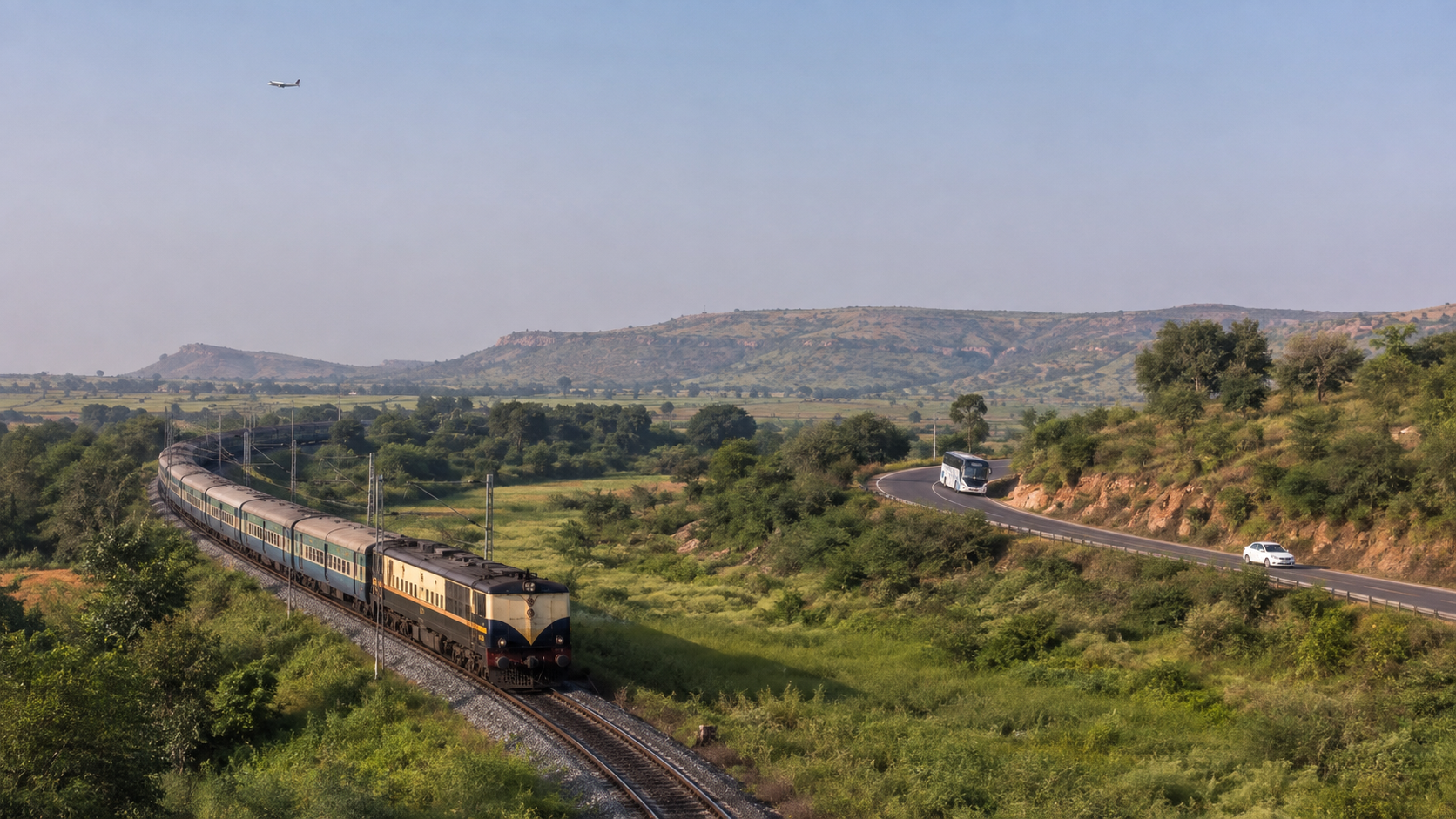

A practical guide to getting around India by train, domestic flight, bus and private driver, including booking advice, costs, safety tips, rail classes and the best transport for popular routes.
India begins to make sense when you move through it.
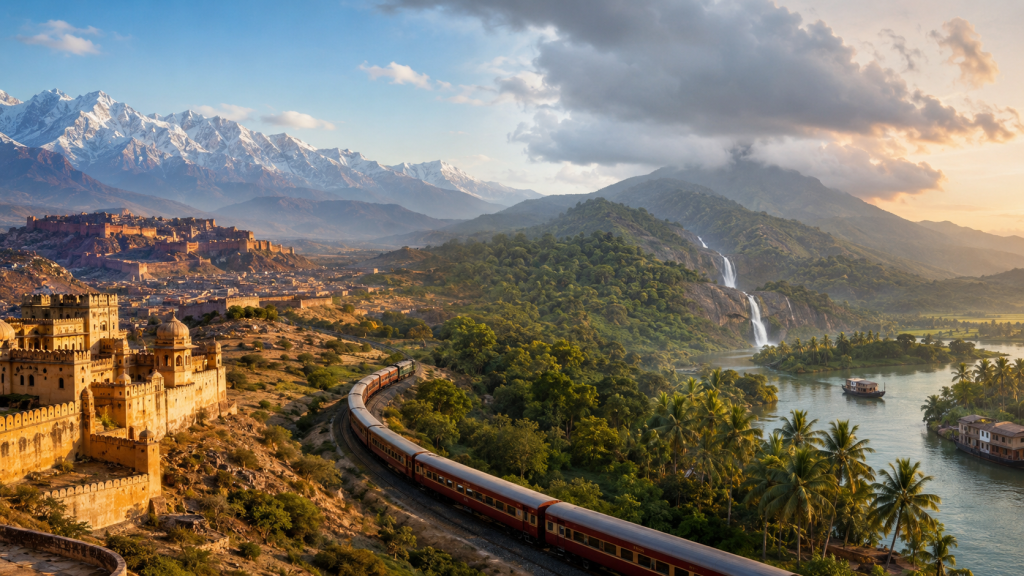
From a train window, the towers of Delhi loosen into mustard fields, brick kilns and villages gathered beneath peepal trees. On an overnight bus, the lights of one state disappear while another wakes beyond the glass. A domestic flight can lift you from Rajasthan’s dry ochre landscape and place you beside Kerala’s coconut-fringed waterways before dinner. Even a road journey has its own rhythm: chai at a highway stall, temple music drifting through a market town and a driver who knows exactly where to stop for hot parathas.
Getting around India can feel complicated at first. The distances are vast, railway booking codes look like a secret language, bus quality varies enormously and a cheap flight is not always cheap once baggage and airport transfers are added. Yet the system becomes surprisingly manageable when you stop looking for one perfect mode of transport.
The best way to travel around India is usually a mixture. Use trains for comfortable journeys between well-connected cities, flights for genuinely long distances, buses where the rail network is indirect, and a private car with a driver when the road itself holds worthwhile stops.
This guide explains how to get around India by train, plane, bus and private driver, including how to book, which class to choose, what journeys suit each option and how to travel with greater comfort and confidence.
Getting around India at a glance
| Transport | Best for | Main advantage | Main drawback |
|---|---|---|---|
| Train | Journeys of roughly 2 to 12 hours and overnight routes | Atmospheric, affordable and city-centre to city-centre | Popular trains and comfortable classes sell quickly |
| Domestic flight | Long cross-country journeys and limited itineraries | Saves a full day or overnight transfer | Airport time, baggage fees and delays reduce the saving |
| Bus | Routes without a convenient train, hill regions and some overnight journeys | Extensive network and frequent departures | Comfort, driving standards and boarding points vary |
| Private car and driver | Families, small groups, rural areas and routes with sightseeing stops | Flexible, door-to-door and convenient with luggage | Costs more and long road days can be tiring |
Short answer: Choose trains for the experience as well as the journey, fly when the overland alternative would consume a precious day, take buses for useful gaps in the rail network, and hire a driver when flexibility matters more than the lowest price.
How to choose the right transport in India
Do not choose by distance alone. A 250-kilometre journey can take two hours on a fast train or most of a day on a mountain road. A flight that lasts 90 minutes may require an hour to the airport, an early check-in, baggage collection and another long transfer at the far end.
Compare the complete journey from hotel door to hotel door. Then consider four things:
- Time: Will the journey take away a useful sightseeing day, or can it happen comfortably overnight?
- Comfort: Are you happy with a sleeper berth or reclining bus seat, or will you need proper rest after several active days?
- Experience: Is the changing landscape part of what you came to India to see?
- Reliability: Does the journey connect with an international flight, a safari or another booking that cannot easily be moved?
If a missed connection would be expensive, build in a buffer. Return to your international departure city the previous day and avoid constructing tight self-connections from separate tickets.
Travelling around India by train
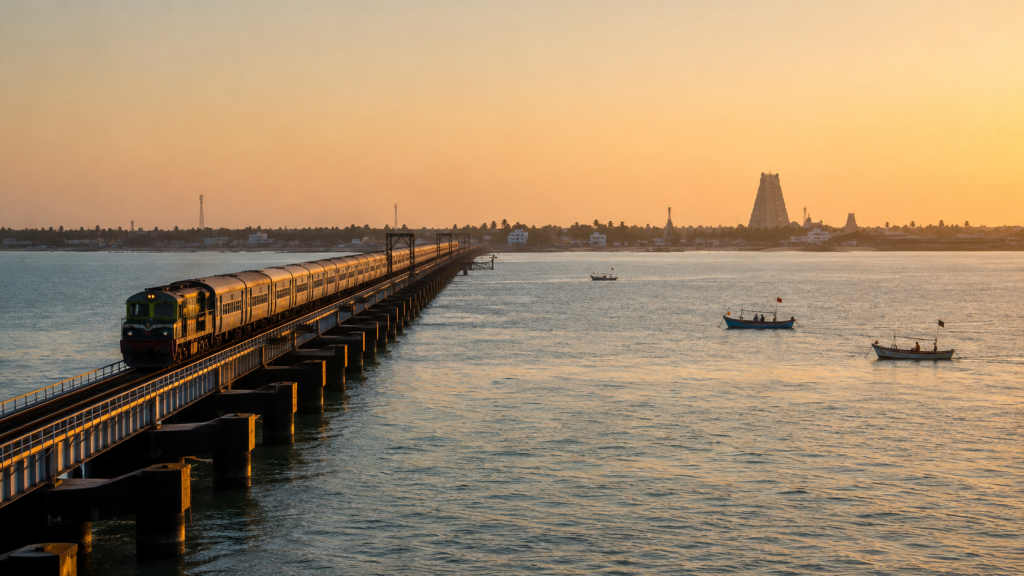
For many visitors, the railway becomes one of the defining experiences of India. Stations are worlds in themselves. Porters weave through families and luggage, steel kettles clink against paper cups, departure boards flicker and the familiar call of “chai, chai” follows the carriages down the platform.
Indian Railways connects major cities, pilgrimage towns, coastal regions and many smaller places. A train often deposits you closer to the historic centre than a flight, while an overnight service can save both a hotel night and a daytime transfer.
It is not always the fastest option, and first-time booking can be frustrating. The reward is a form of travel that lets you see the country change gradually rather than simply reappear beyond another arrivals hall.
Which Indian train class should you choose?
| Code | Class | What to expect | Best for |
|---|---|---|---|
| 1A | First AC | Air-conditioned two- or four-berth compartments with lockable doors on many trains; bedding normally supplied | Privacy, families and the highest overnight comfort |
| 2A | AC 2-Tier | Open bays with two levels of berths, side berths and curtains on many services; bedding normally supplied | The best all-round overnight choice for many international travellers |
| 3A | AC 3-Tier | Three levels of berths in open bays; air-conditioned, sociable and busier than 2A | Good-value overnight journeys |
| 3E | AC 3-Tier Economy | A denser air-conditioned sleeper layout, usually with more berths per coach | Budget travellers who still want air conditioning |
| EC | Executive Chair Car | Spacious premium seating on selected daytime trains | Short, fast intercity journeys with extra comfort |
| CC | AC Chair Car | Reserved air-conditioned airline-style seating | Day trains such as Delhi to Agra |
| SL | Sleeper | Open sleeper berths without air conditioning; fans and open windows | Experienced budget travellers in suitable weather |
| 2S | Second Sitting | Basic reserved seating without air conditioning | Short, inexpensive daytime trips |
For a first overnight train, AC 2-Tier is the easiest balance of space, comfort and atmosphere. AC 3-Tier costs less and remains perfectly workable if you are comfortable with a busier coach. For daytime journeys, AC Chair Car is usually enough.
First AC is not always dramatically faster or newer than the other air-conditioned classes. You are paying mainly for fewer passengers and greater privacy. Coach condition varies by train, and “AC” describes the class rather than guaranteeing a silent luxury journey.
Train types you will encounter
India has many named and numbered services, but visitors most often notice a few broad types:
- Vande Bharat Express: modern daytime trains connecting an expanding range of cities, usually with Chair Car and Executive Chair Car.
- Shatabdi Express: fast daytime intercity trains with reserved air-conditioned seating.
- Rajdhani Express: long-distance air-conditioned trains linking Delhi with major cities, often suited to overnight travel.
- Duronto Express: limited-stop long-distance services on selected routes.
- Mail and Express trains: the broad network of long-distance services with several classes and more intermediate stops.
Choose by departure time, duration, arrival station and class availability rather than assuming a famous train name is automatically the best option. A slightly slower service that arrives in daylight can be more convenient than one that leaves you outside a station at 4 am.
How to book Indian trains as an international traveller
Book directly through the official IRCTC website. International users can register with a foreign mobile number, verify the account and pay the applicable registration charge. Create the account before tickets open because identity verification and unfamiliar payment screens are not something you want to handle while seats disappear.
The normal advance reservation period is currently 60 days before departure, excluding the journey date, for most trains. Popular routes, holiday periods and air-conditioned sleeper classes can sell out quickly.
Foreign visitors and non-resident Indians holding valid passports can also use IRCTC’s Foreign Tourist Quota on eligible trains and classes. This facility allows booking up to 365 days ahead, although a berth booked beyond the normal reservation window is allocated later when that window opens. The quota is limited and carries additional charges, but it can be extremely useful when general availability has disappeared.
Enter every passport number carefully and carry the original passport used for the booking. Save the ticket offline as well as in your email because mobile data can be unreliable at exactly the wrong moment.
Understanding CNF, RAC and waiting-list tickets
- CNF or Confirmed: you have a confirmed place. The coach and berth may appear immediately or after the chart is prepared.
- RAC or Reservation Against Cancellation: you may board and have a seat, but you might initially share a berth. It can become fully confirmed as other passengers cancel.
- WL or Waiting List: you do not yet have a confirmed place. Different waiting-list codes have different probabilities of clearing.
Do not build an essential journey around a remote chance of confirmation. If every passenger on an electronic booking remains fully waitlisted after the final chart, the booking is normally cancelled automatically and those passengers cannot board on that ticket. Check the live status before leaving for the station and have another plan where the journey matters.
Can foreign visitors use Tatkal?
Tatkal is the last-minute quota that opens one day before a selected train departs from its originating station. Online Tatkal booking through IRCTC is currently restricted to Aadhaar-authenticated users and requires Aadhaar-based verification. Most short-term foreign visitors do not have Aadhaar, so they should not rely on online Tatkal as a rescue plan.
Rules for counter and authorised-agent bookings include mobile OTP verification and can change. For an international trip, the calmer strategy is to book within the standard window, use the Foreign Tourist Quota where eligible, change class or train, or choose a reputable bus or flight.
Practical train tips
- Check the train number, station code and boarding station, not just the city name. Delhi and other major cities have several long-distance stations.
- Arrive at least 30 to 45 minutes early for a large unfamiliar station.
- Use the coach-position display on the platform so you are waiting near the correct part of a long train.
- Keep passport, money, phone and medication in a small bag attached to you. Secure larger luggage to the berth frame with a light cable lock if it helps you relax.
- Carry water, tissues, hand sanitiser and a layer for heavily air-conditioned coaches.
- Pack food for dietary needs or a sensitive stomach, even when meals are included or available.
- Set an alarm before your stop, especially at night. Trains can recover or lose time during the journey.
- Never accept an unofficial claim that your train is cancelled and you must buy a replacement tour or taxi. Verify through IRCTC, station staff or the official railway enquiry system.
Travelling around India by domestic flight
Flying is not a defeat for the romantic traveller. India is vast. Delhi to Kochi, Varanasi to Mumbai or Rajasthan to the Northeast can consume an entire day and night by surface transport. If you have two weeks rather than two months, a carefully chosen flight protects time for the places you came to experience.
Flights make the most sense when the train takes more than about 12 to 15 hours, the rail route requires an awkward change, or the journey connects regions that are poorly linked overland. They make less sense on routes such as Delhi to Agra, where reaching and leaving the airport can take longer than a fast train.
How to book domestic flights well
- Search using the exact airport, not only the city. Some destinations are served by an airport a long drive away.
- Compare the airline’s final price after checked baggage, seat selection and payment charges.
- Check baggage allowance for the specific fare. Indian domestic fares often separate basic cabin-only or low-baggage options from more inclusive tickets.
- Book directly with the airline when the saving through an unknown intermediary is small. Changes and refunds are usually easier to manage.
- Keep flights on one ticket where possible. If you create your own connection from separate bookings, leave a generous gap or an overnight stay.
- Use the airline’s app or website to check in and monitor terminal changes, but keep the booking reference offline.
Baggage policies differ by carrier and fare, so verify them shortly before travel. Do not assume the allowance from your international flight continues onto a separately booked domestic ticket. A trekking backpack, camera kit or additional suitcase can turn the cheapest fare into the most expensive.
If a flight is heavily delayed, cancelled or oversold, consult the Ministry of Civil Aviation’s Passenger Charter of Rights and the airline’s current policy. Keep screenshots of notifications and receipts for expenses you may need to claim.
When flying is worth it
| Route type | Usually sensible? | Reason |
|---|---|---|
| Delhi to Agra | No | A fast train is normally easier and more central |
| Delhi to Varanasi | Sometimes | Fly for time; take an overnight train for experience and value |
| Udaipur to Mumbai | Often | A flight can protect most of a day |
| Varanasi to Mumbai | Usually | The overland journey is long for a short itinerary |
| Delhi to Kochi | Yes | Connects distant regions efficiently |
| Delhi or Kolkata to Northeast India | Often | Useful gateway flights reduce complex surface journeys |
Travelling around India by bus
Buses reach many places that trains do not. They climb into Himalayan towns, cross Rajasthan between cities with indirect rail links, connect Goa with Hampi and fill the web of shorter journeys between districts.
The word “bus” covers very different experiences. It can mean a basic state service with open windows and frequent stops, an air-conditioned Volvo-style coach with reclining seats, or an overnight sleeper bus with individual berths. Read the vehicle type and recent reviews rather than judging by the route alone.
Government and private buses
State road transport corporations operate extensive regional networks. Their better air-conditioned services can be dependable and good value, while ordinary buses offer a wonderfully local experience on shorter daytime journeys. Official state booking sites and bus-station counters are the most direct sources.
Private operators often provide more departure times, sleeper layouts and direct connections. Established booking platforms can help compare boarding points, vehicle types and passenger feedback, but always verify the operator, cancellation terms and exact pick-up location.
Seater, semi-sleeper or sleeper?
- AC seater: suitable for shorter daytime journeys.
- AC semi-sleeper: reclining seats with more legroom, useful for medium-distance travel.
- Sleeper bus: horizontal or near-horizontal berths for overnight routes, but road movement can make sleep difficult.
- Non-AC ordinary bus: inexpensive, frequent and best kept to shorter trips unless you already know you enjoy basic local transport.
On an overnight bus, a lower berth usually moves less than an upper berth, while a berth near the middle feels steadier than one above the rear axle. Solo travellers may prefer a clearly marked single berth. Keep valuables with you rather than in the luggage hold.
Bus travel tips
- Check whether the “station” is actually a roadside pick-up point, private office or petrol station.
- Choose an arrival before late evening when the destination and onward transfer are unfamiliar.
- Allow for traffic and weather, especially during the monsoon and on mountain roads.
- Use recent reviews to assess punctuality, vehicle condition and whether the advertised bus is normally supplied.
- Carry a light layer, water and motion-sickness medication if you use it.
- Share the vehicle number and live location with someone you trust on overnight journeys.
Mountain routes deserve extra caution. Landslides, fog, road works and seasonal closures can transform a timetable. Travel in daylight when possible and ask locally about current road conditions rather than trusting an old online schedule.
Hiring a private car and driver in India
A private driver can be the most sensible choice without turning your trip into a packaged tour. It works particularly well for two to four people sharing the cost, families with children, travellers with limited mobility and routes where the best places sit between railway stations.
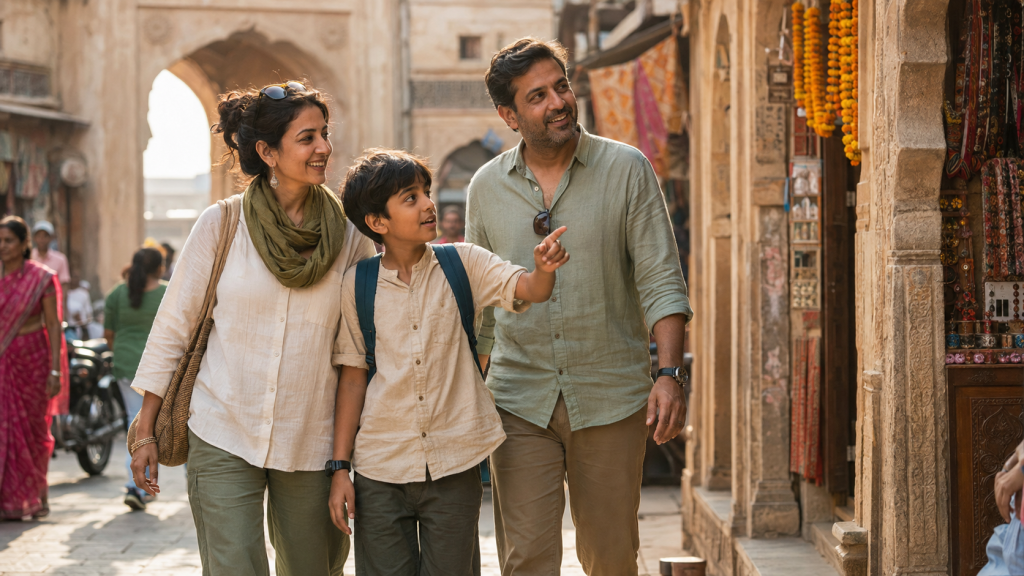
Agra to Jaipur via Fatehpur Sikri is a classic example. Jodhpur to Udaipur via Ranakpur is another. The driver gives you door-to-door transport and luggage freedom, while the journey becomes a day of exploration rather than dead time.
What to agree before you book
Ask for the quote in writing and confirm whether it includes:
- vehicle type, air conditioning and luggage capacity;
- fuel and the daily kilometre allowance;
- tolls, parking and interstate taxes;
- driver meals and accommodation on multi-day trips;
- airport or late-night surcharges;
- extra kilometres, waiting time and changes to the route;
- cancellation terms and accepted payment method.
A driver is not automatically a licensed sightseeing guide. Some drivers offer useful local suggestions, but book an accredited guide separately when you want detailed historical interpretation.
How to choose a reputable driver
Use a well-reviewed local company, a recommendation from a trusted hotel or homestay, or a provider listed through the Ministry of Tourism’s NIDHI tourism service directory. Ask for the company name, driver’s name, vehicle registration and emergency contact before departure.
On collection, check that the vehicle has functioning seat belts where fitted, working air conditioning if promised, enough room for luggage and no obvious safety problems. Do not pressure a driver to cover unrealistic distances. Fatigue is a risk, and a ten-hour road day remains tiring even when you are not driving.
If the driving feels unsafe, say so clearly. Ask for a slower pace, a break or a replacement through the company. Your itinerary is never more important than arriving safely.
What does transport in India cost?
These broad planning ranges are indicative, not fixed fares. Prices vary by route, train, demand, season, vehicle and how early you book. Dollar figures use roughly ₹95 to US$1, close to the exchange rate in August 2026.
| Journey or service | Indicative price | Approximate US dollars |
|---|---|---|
| Short intercity train in AC Chair Car | ₹600–₹1,500 | US$6–$16 |
| Overnight train in AC 3-Tier | ₹1,000–₹2,500 | US$11–$26 |
| Overnight train in AC 2-Tier | ₹1,800–₹4,000 | US$19–$42 |
| Air-conditioned intercity bus | ₹500–₹2,000 | US$5–$21 |
| Typical domestic flight booked ahead | ₹3,500–₹10,000 | US$37–$105 |
| Private car and driver for a full intercity day | ₹3,000–₹7,000 per vehicle | US$32–$74 per vehicle |
Special trains, dynamic airfares, premium buses and remote road routes may cost more. A car quotation can also rise with tolls, state taxes, extra distance and driver expenses. Treat the table as a first budget, then compare real fares for your exact date.
Local transport inside Indian cities
Intercity planning receives most of the attention, but daily city movement often determines how tiring a trip feels.
Metro systems
Delhi, Mumbai, Bengaluru, Kolkata, Chennai, Hyderabad, Kochi, Jaipur and several other cities have urban rail or metro systems. They are often the fastest way to cross congested areas. Buy a stored-value card where useful, follow security rules and avoid carrying more luggage than you can manage through stairs and crowds.
App-based taxis and prepaid counters
App-based ride services operate in many cities, although coverage and reliability vary. Confirm the registration number before entering, check that the route has started in the app and avoid paying an unofficial extra charge that was not agreed. At airports and major stations, official prepaid taxi desks can be reassuring when mobile data or app availability fails.
Auto-rickshaws
An auto-rickshaw ride is one of India’s small exhilarations: open air, bright paintwork and a close view of the street unfolding around you. Use the meter where it is standard, or agree the price before setting off. Ask your accommodation for a realistic fare, keep small notes and show the destination on a map as well as saying its name.
Local buses, ferries and suburban trains
Local buses are cheap and immersive but can be crowded and difficult to interpret without local help. Suburban trains in Mumbai and other cities are efficient for commuters but intimidating with luggage and extremely busy at peak times. Public ferries can be a pleasure in places such as Kochi, Mumbai and the Kerala backwaters, turning ordinary transport into one of the day’s best views.
The best transport for popular India routes
| Route | Best first choice | Useful alternative |
|---|---|---|
| Delhi to Agra | Fast morning train | Private car if continuing via roadside sights |
| Agra to Jaipur | Car and driver via Fatehpur Sikri | Direct train or bus |
| Jaipur to Jodhpur | Train | Bus or private car |
| Jodhpur to Udaipur | Car via Ranakpur | Bus, because direct rail is less convenient |
| Delhi to Varanasi | Overnight train or flight | Choose by time and budget |
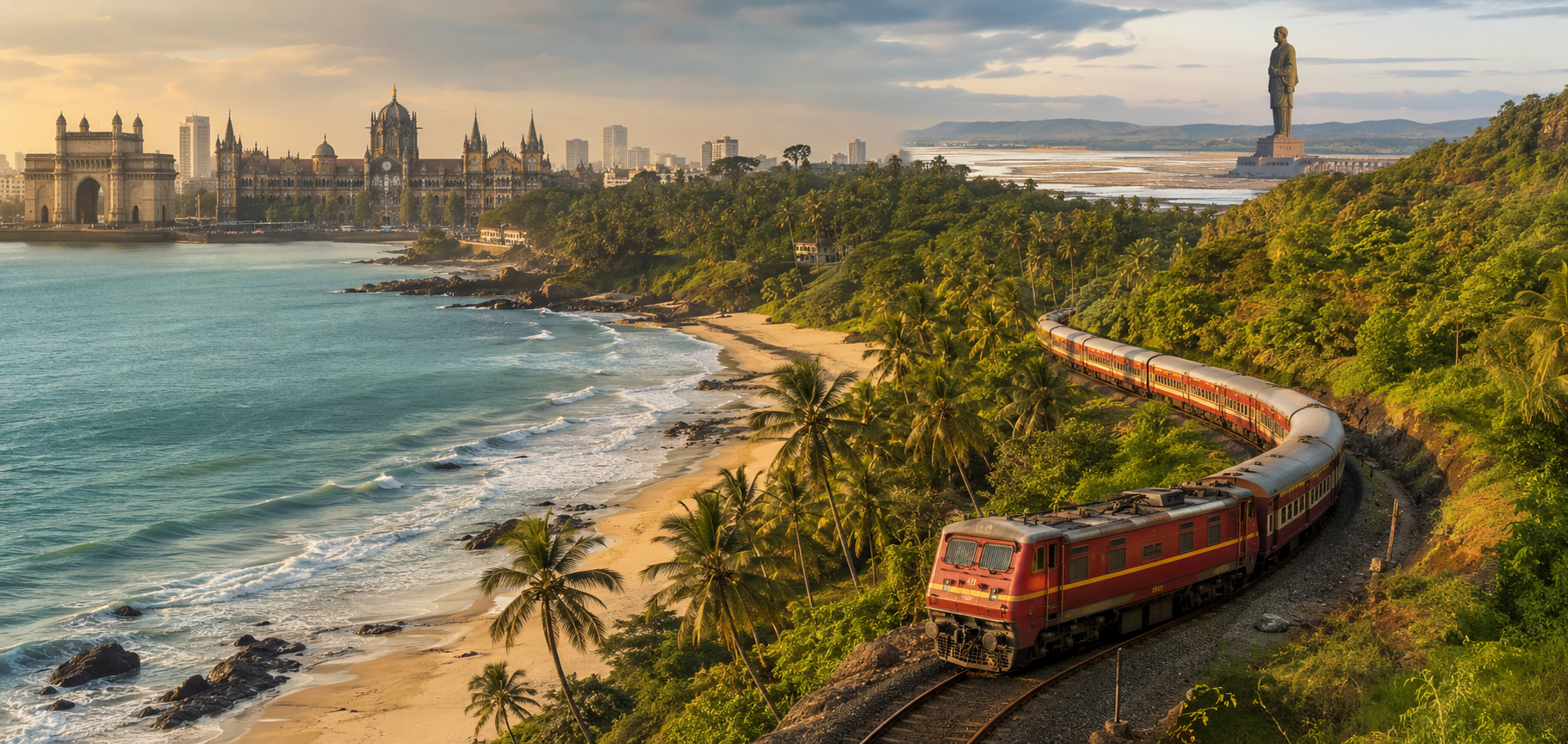
| Mumbai to Goa | Konkan Railway train for scenery | Flight for speed |
| Goa to Hampi | Overnight bus or private car | Train connection via Hosapete where practical |
| Kochi to Alappuzha | Train or private car | Bus, then local ferry for the backwaters |
| Delhi to Kochi | Flight | Long-distance train only if the journey itself appeals |
| Guwahati to Kaziranga | Car or reputable shared transfer | Bus, followed by local transport |
For a realistic route that combines these modes, read our India itineraries for 7 days, 2 weeks, 3 weeks and one month. If you are beginning with Delhi, Agra and Jaipur, our Golden Triangle itinerary explains exactly where a train, car or flight works best.
Safety and comfort while travelling around India
India’s transport systems carry enormous numbers of people every day. Most journeys are routine, sociable and uneventful. Sensible habits still make unfamiliar travel easier.
- Keep passports, cards, medication and electronics in your hand luggage.
- Use official booking channels or established operators and be wary of urgent unsolicited help.
- Share long-distance vehicle details and expected arrival time with someone you trust.
- Avoid arriving alone at a poorly connected station or roadside stop in the middle of the night.
- Dress in layers for cold air conditioning and hot platforms.
- Carry drinking water, but reduce single-use plastic by refilling safely where possible.
- Keep small cash for porters, rickshaws, toll stops and places where digital payment is unavailable to foreign cards.
- Trust your instincts. Move to a busier carriage, speak to staff or leave a vehicle if a situation feels wrong.
Women travelling alone may prefer an upper berth in an air-conditioned train coach, a single berth on a reputable sleeper bus and daylight arrivals. India also has women-only compartments on some urban and local services, but arrangements vary by city and train. Ask station staff rather than assuming.
For assistance, Indian Railways uses the integrated helpline 139. The Government of India also operates a 24-hour multilingual tourist helpline on 1363 or 1800-11-1363. Save the numbers before travelling and use India’s national emergency number, 112, for an urgent emergency.
How to build transport into your India itinerary
A common planning mistake is counting a transfer as though it occupies only the hours printed on the ticket. A 7 am train requires packing, checking out and reaching the station. A 3 pm arrival may leave little usable time once you find your hotel and eat.
Count travel days honestly:
- A journey under three hours can often share a day with gentle sightseeing.
- A four- to six-hour road journey usually consumes most of the useful day.
- An overnight train saves daylight only if you can sleep reasonably well.
- A flight between distant regions should usually be treated as at least half a day.
- After every few active transfers, add a slower day with no fixed departure.
Season matters too. Winter fog can disrupt northern trains and flights. Monsoon rain can slow roads and affect mountain routes. Festivals fill trains, buses and hotels. Before fixing the route, compare your dates with our month-by-month guide to the best time to visit India.
Frequently asked questions
What is the best way to get around India?
A combination is best. Use trains for short and medium intercity journeys, flights for long cross-country routes, buses where rail connections are poor and private drivers for flexible road itineraries with stops.
Is it easy for foreigners to book Indian trains?
It becomes straightforward once an international IRCTC account is registered and verified. Create the account early, book when the reservation window opens and keep your passport details exact. The Foreign Tourist Quota may help on eligible trains when general availability is limited.
How far ahead can I book a train in India?
The normal advance reservation period is currently 60 days before the journey date for most trains. Eligible international users can book selected Foreign Tourist Quota tickets up to 365 days ahead. Always confirm current rules through IRCTC because railway policies can change.
Are Indian trains safe for tourists?
Reserved air-conditioned classes are widely used by domestic and international travellers. Normal precautions apply: keep valuables close, secure larger luggage, verify information through official sources and avoid isolated station areas late at night.
Are domestic flights expensive in India?
Flights can be good value when booked ahead, but prices rise around holidays and close to departure. Compare checked baggage, seat fees and airport transfers rather than only the headline fare.
Should I take an overnight train or sleeper bus?
Choose the train where both options are convenient. Trains usually offer more space to move, toilets and a smoother ride. A sleeper bus becomes useful when it is direct and the rail route is indirect or unavailable.
Is hiring a private driver in India expensive?
For one traveller it costs more than public transport, but two to four people sharing can make it reasonable. It also saves station transfers, carries luggage easily and allows worthwhile stops, so compare overall value rather than fare alone.
Do I need to tip a private driver?
A tip is customary for good service but should not replace a fair quoted wage. The amount depends on journey length, group size and service. Ask a reputable local company or hotel for current guidance and give the tip directly at the end.
Final thoughts
Getting around India is not simply the space between the places you came to see.
It is the first light reaching a railway platform while someone pours sweet chai through a strainer. It is the long road into the Aravalli hills, a bus conductor remembering where you need to get off, or the sudden green of the Konkan coast opening beyond the train window. These journeys reveal scale, rhythm and ordinary life in a way that airports and hotel rooms cannot.
Plan the important legs early, choose comfort where it protects your energy and fly without guilt when distance demands it. Then leave room for the journey itself. India rarely unfolds in a straight line, and that is often where its deepest pleasures begin.
If this is your first visit, begin with our complete India travel guide for entry planning, budgets, health, culture and the practical decisions that shape a rewarding trip.