Now Reading: A Traveller’s Guide to Indian Food: What to Eat in Every Region
-
01
A Traveller’s Guide to Indian Food: What to Eat in Every Region
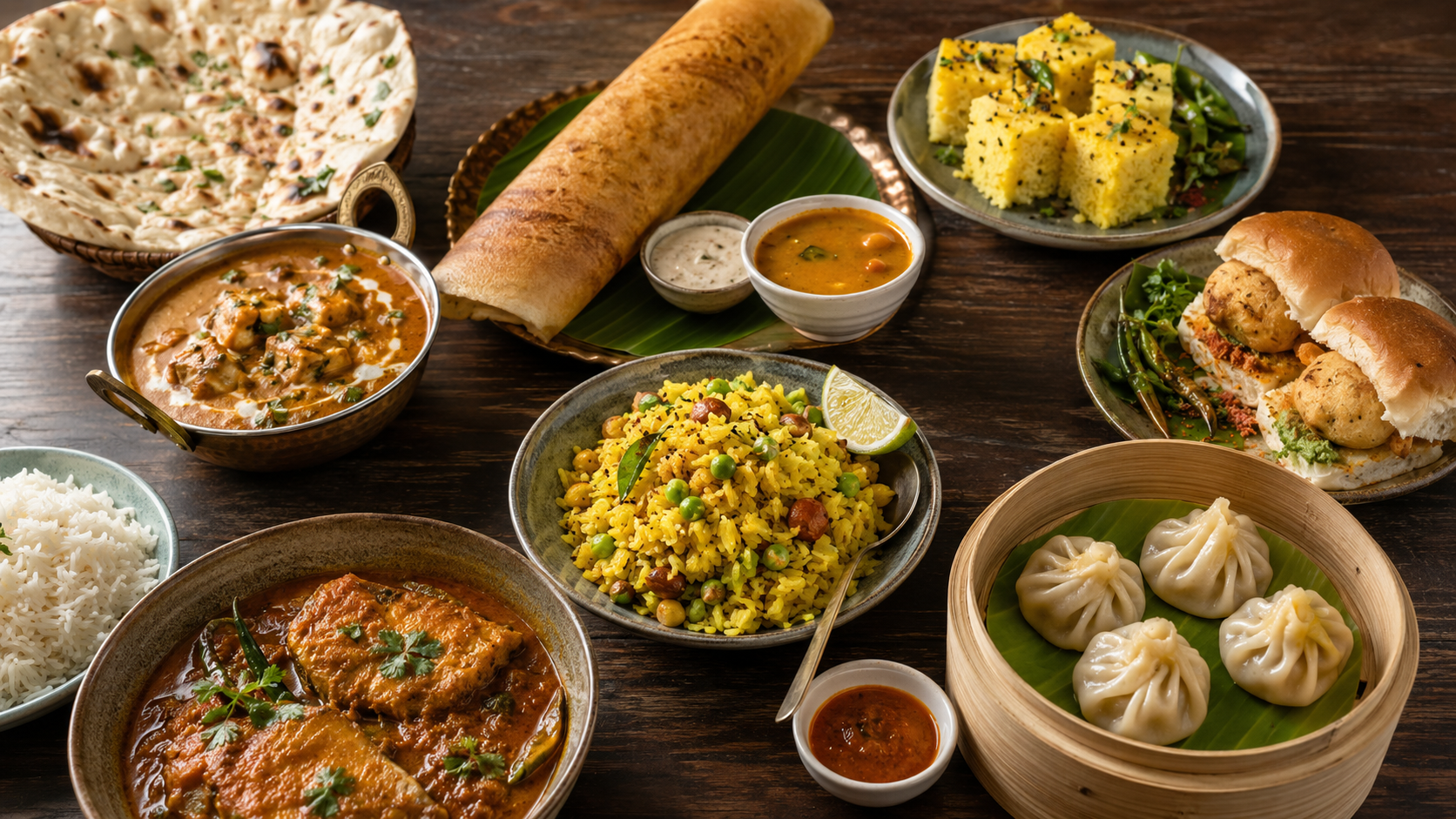

From Punjabi tandoors and Rajasthani thalis to Kerala seafood, Bengali sweets and Northeast Indian specialities, discover what to eat across every region of India.
India often reaches you through its food before you fully understand where you are. It is there in the buttery hiss of a dosa meeting a hot iron griddle, the smoke curling from a tandoor in Amritsar, the sharp scent of mustard oil in Kolkata and the quiet warmth of rice, ginger and smoked meat in the hills of Nagaland.
This Indian food guide is for travellers who want to taste the country rather than simply order the same familiar curry in every city. Indian cuisine changes with the landscape. Wheat gives way to rice, mustard oil to coconut, rich gravies to broths, and royal kitchens to tribal cooking traditions. Sometimes the flavour changes within a few hours of travel.
You do not need to recognise every dish before you arrive. You only need curiosity, a little practical knowledge and the confidence to ask, “What is local here?” This guide will help you know what to eat in every region of India, how to order, what to try as a vegetarian and how to enjoy street food more safely.
Indian food by region: a quick guide
| Region | Flavours and staples | Good first dishes to try |
|---|---|---|
| North India | Wheat breads, dairy, tandoor cooking, slow-cooked meat, warming spices | Amritsari kulcha, dal makhani, chaat, dal baati churma, rogan josh |
| South India | Rice, lentils, coconut, tamarind, curry leaves, pepper and seafood | Masala dosa, idli, appam, sadya, Hyderabadi biryani, Chettinad chicken |
| West India | Coastal seafood, kokum, coconut, peanuts, millet and lively street food | Vada pav, misal pav, Goan fish curry, dhokla, undhiyu |
| East India | Rice, fish, mustard, poppy seeds, temple food and delicate sweets | Shorshe fish, kosha mangsho, dalma, litti chokha, chhena poda |
| Central India | Grains, lentils, forest produce and a mix of northern and western influences | Poha-jalebi, dal bafla, bhutte ka kees, fara |
| Northeast India | Rice, herbs, fermented ingredients, bamboo shoot, smoked meat and light broths | Masor tenga, eromba, jadoh, smoked pork with axone, thukpa |
These are broad signposts, not rigid borders. A coastal district may eat very differently from an inland city in the same state, while religion, season, community and family tradition all shape the plate. That variety is precisely what makes food travel in India so rewarding.
First, forget the idea of a single “Indian cuisine”
Restaurant menus outside India often place dishes from many parts of the country side by side. In India, the experience is more layered. Punjabi food is not Kashmiri food. Tamil cooking is not the same as Kerala cooking. Bengali fish, Naga smoked pork and Gujarati vegetarian thali belong to very different culinary worlds.
Climate and geography explain much of this. Wheat and dairy are prominent across parts of the north. Rice anchors meals in the south, east and northeast. Long coastlines bring fish, prawns and coconut into everyday cooking. Dry landscapes encourage the use of millet, pulses, pickles and preserved ingredients. Trade, migration, royal courts, temple kitchens and indigenous food traditions have added further layers over centuries.
Use this guide alongside our complete India travel guide, then follow your appetite as naturally as your itinerary.
North Indian food: tandoors, breads, kebabs and mountain warmth
North Indian food is the version many international travellers think they already know, but eating it in its home region feels entirely different. Fresh bread arrives blistered from the tandoor. Lentils carry the depth of hours spent over a low flame. Street-side chaat is assembled in seconds, yet lands on the tongue with sweet, sour, salty, spicy and crunchy notes all at once.
Delhi and Uttar Pradesh
Delhi is one of the easiest places to begin a culinary journey. In Old Delhi, try chole bhature, parathas, seekh kebabs, nihari and the many forms of chaat. A plate of papdi chaat may combine crisp wafers, potato, yoghurt, tamarind chutney, mint and sev. It looks chaotic, but every texture has a purpose.
In Lucknow, look for the gentler perfume of Awadhi cooking. Galouti kebab, traditionally soft and deeply spiced, is often eaten with a thin ulte tawa paratha. Awadhi biryani is fragrant rather than aggressively hot, while korma and slow-cooked meat dishes reflect the city’s courtly culinary history. In Varanasi, start early with kachori sabzi, then finish with jalebi or a clay cup of thick lassi.
Punjab
Punjab cooks with generosity. In Amritsar, break open an Amritsari kulcha and let its crisp, butter-brushed layers fall into chickpea curry. Try dal makhani, sarson da saag with makki di roti, Amritsari fish and smoky tandoori chicken. A simple meal at a dhaba can be as memorable as any formal restaurant.
If you visit the Golden Temple, the langar, or community kitchen, offers a deeply meaningful meal. Everyone sits together and receives simple vegetarian food. Dress respectfully, cover your head, follow volunteers’ guidance and accept only what you can finish.
Rajasthan
Rajasthan’s arid landscape produced food that is ingenious, robust and often made from ingredients that store well. The classic dal baati churma combines lentils, baked wheat balls and a sweet, crumbly mixture enriched with ghee. Also try gatte ki sabzi, gram-flour dumplings in yoghurt gravy, ker sangri, made with desert berries and beans, and fiery laal maas if you eat meat.
A Rajasthani thali is the easiest introduction. Let the server explain what belongs with what, and taste each preparation before combining it with bread or rice.
Kashmir and the Himalayan north
Kashmiri food is aromatic, layered and shaped by several communities. Meat eaters can explore dishes associated with a wazwan feast, including rogan josh, rista and gushtaba. Vegetarian travellers should look for haak saag, dum aloo and nadru yakhni, lotus stem in a yoghurt-based sauce. Sip kahwa, a fragrant tea often prepared with saffron, cardamom or nuts.
Across Himachal Pradesh, Uttarakhand and Ladakh, mountain food becomes simpler and warming. Depending on where you travel, look for siddu, stuffed steamed bread, madra, kafuli, momos and bowls of thukpa. Explore the region in more depth with our North India travel guide.
South Indian food: rice, coconut, tamarind and breakfast worth waking for
Morning in South India has its own soundtrack: steel tumblers meeting saucers, ladles spreading dosa batter and vendors calling over the scent of filter coffee. Rice and lentils appear in countless forms, from soft steamed idlis to crisp dosas, while coconut, tamarind, black pepper, curry leaves and seafood shift in character from coast to interior.
Tamil Nadu
Begin with idli, vada, pongal or a paper-thin dosa served with sambar and several chutneys. Eat with your right hand if comfortable, tearing and dipping as locals do. At lunch, order a Tamil meals plate, often a rice-centred spread of vegetables, sambar, rasam, curd and pickle served on a banana leaf or steel tray.
Chettinad cuisine brings pepper, fennel and freshly ground spices to chicken, mutton, seafood and vegetables. Try nattukozhi kuzhambu, country chicken curry, or a vegetable preparation with parotta. Tamil cooking contains far more than idli and dosa, with distinct Chettinad, Kongunadu, Thanjavur and temple traditions.
Kerala
Kerala tastes green, coastal and fragrant. Tear a lace-edged appam into vegetable or meat stew, try puttu with kadala curry for breakfast, and seek out a fresh meen curry, fish curry, with rice. On the Malabar coast, biryani, pathiri and seafood carry the history of Indian Ocean trade.
A vegetarian sadya is one of India’s great shared meals. Served on a banana leaf, it may include rice, sambar, avial, thoran, olan, pickles, pappadam and payasam. The order and composition can vary, especially during festivals and celebrations. Do not rush it.
Karnataka
Karnataka moves from the comforting bisi bele bath of the interior to coastal neer dosa, Mangalorean fish curry and kori rotti. In Bengaluru, try rava idli, masala dosa and strong filter coffee at an old-style darshini, a quick, usually standing-service eatery. Finish with a small square of ghee-rich Mysore pak.
Andhra Pradesh and Telangana
Andhra cooking has a reputation for heat, but its sour, tangy and earthy flavours are equally important. Look for gongura, a tart leafy green used in chutneys and meat dishes, pesarattu, a green gram crepe, and generous Andhra meals served with rice.
In Hyderabad, the perfume of Hyderabadi biryani is difficult to resist. Also try haleem when seasonally available, mirchi ka salan and double ka meetha. For a wider journey through the peninsula, use our South India travel guide.
West Indian food: coastal curries, vegetarian thalis and irresistible snacks
Western India can take you from a paper-wrapped vada pav eaten beside a Mumbai station to a slow Gujarati thali, then onwards to a Goan fish curry scented with coconut and kokum. This is a region of big contrasts and exceptionally good snack culture.
Maharashtra
Mumbai’s defining foods are democratic, portable and full of personality. Start with vada pav, a spiced potato fritter tucked into bread with chutneys. Move on to pav bhaji, bhel puri or misal pav, a sprouted lentil curry layered with crunchy farsan, onion and lemon.
Beyond Mumbai, Maharashtrian food changes quickly. Try puran poli, bharli vangi and millet bhakri. Along the Konkan coast, look for Malvani seafood and cool, pink-tinged sol kadhi, made with kokum and coconut milk.
Goa
Goan cuisine carries coastal, Konkan and Portuguese influences, but it should never be reduced to vindaloo alone. A local fish curry rice is the essential everyday plate. Also seek out xacuti, cafreal, prawn balchão, pork vindaloo and bebinca, a layered dessert traditionally made with coconut milk and eggs.
Ask whether a dish contains pork, vinegar, dried shrimp or fish stock if you have dietary restrictions. Ingredients that are not visible can still be central to the flavour.
Gujarat
Gujarati cuisine shows how varied vegetarian cooking can be. A thali may move between sweet, salty, tangy and spicy flavours, with dal, kadhi, vegetables, pulses, breads, rice, chutneys and a small sweet served together. Try dhokla, khandvi, thepla, handvo and, in season, undhiyu.
In Kutch and Saurashtra, millet breads, garlic chutneys and regional vegetable dishes reflect a drier landscape. Our West India travel guide helps connect these flavours with a practical route.
East Indian food: mustard, fish, temple kitchens and delicate sweets
In eastern India, a spoonful of mustard can feel sharp enough to wake every sense. Fish may be steamed in leaves, vegetables cooked with poppy seeds, and sweets made from fresh curd cheese. Yet travel inland and the plate shifts again towards sattu, seasonal greens and hearty grain-based food.
West Bengal
A Bengali meal often unfolds in courses, moving from vegetables and dal towards fish or meat, then chutney and sweets. Look for shorshe ilish, hilsa in mustard sauce when available, macher jhol, chingri malai curry, kosha mangsho and luchi with alur dom.
Kolkata’s streets add their own temptations: kathi rolls, jhal muri, telebhaja and puchka. Finish with mishti doi, sandesh or roshogolla. Ask for a small portion first because the sweet counter can make restraint difficult.
Odisha
Odia food can be subtle, seasonal and deeply connected to temple traditions. Try dalma, lentils cooked with vegetables, pakhala bhata, fermented or water-soaked rice especially refreshing in hot weather, and machha besara, fish in mustard gravy.
In Puri, the food traditions surrounding the Jagannath Temple carry profound religious meaning. Follow local rules carefully because access and food customs at sacred sites may differ for visitors. Away from the temple, look for chhena poda, a caramelised baked cheese dessert with a smoky edge.
Bihar and Jharkhand
Litti chokha is Bihar’s best-known dish: roasted wheat balls filled with seasoned sattu, served with mashed aubergine, tomato or potato and often ghee. Also try sattu paratha, thekua and regional sweets such as khaja.
In Jharkhand, search beyond generic restaurant menus for dhuska, a fried rice-and-lentil bread, chilka roti and seasonal dishes made with local greens or forest produce. Read our East India travel guide when planning this less hurried food journey.
Central Indian food: grain, forest produce and Indore’s late-night appetite
Central India is sometimes missed in food itineraries, which is a mistake. Madhya Pradesh brings together Malwa, Bundelkhand and other distinct traditions, while Chhattisgarh draws deeply from rice, millets, leafy vegetables and indigenous food knowledge.
Madhya Pradesh
In Indore, breakfast means poha scattered with sev and coriander, often followed by hot jalebi. Later, try bhutte ka kees, grated corn cooked with milk and spices, and dal bafla, wheat dough balls served with dal and ghee.
Indore’s Sarafa Bazaar becomes a food market after the jewellery shops close. It is energetic, bright and built for grazing. Share portions so you can try more than one dish, and choose stalls cooking food fresh in front of a steady crowd.
Chhattisgarh
Chhattisgarhi food is often simple, nourishing and underrepresented on mainstream Indian menus. Look for fara, steamed rice-flour dumplings, chila, savoury pancakes made from rice or lentil batter, and local rice dishes. Some traditional preparations rely on seasonal or foraged ingredients, so availability changes through the year.
For a broader route through these heartland flavours, see our Central India travel guide.
Northeast Indian food: fermented flavours, fresh herbs and smoked meats
The cuisines of Northeast India are among the country’s most distinctive and most carelessly generalised. Eight states, many ethnic communities and sharply different landscapes produce an enormous range of food. Rice is a common thread, but cooking may feature fermented soybean, bamboo shoot, fresh herbs, smoked meat, river fish and gentle broths rather than the heavy gravies visitors expect from Indian restaurant menus.
Assam
Assamese meals often feel clean, balanced and quietly complex. Try masor tenga, a light and tangy fish curry, khar, a distinctive alkaline preparation, aloo pitika, mashed potato with mustard oil and aromatics, and seasonal pitha. An Assamese thali is a good way to understand how bitter, sour, fresh and fermented elements sit together.
Nagaland
In Nagaland, smoked pork with bamboo shoot or axone, fermented soybean, is an iconic combination. Axone has a powerful aroma and a deep savoury taste. Also look for galho, a comforting rice dish cooked with vegetables or meat, and simple boiled greens that balance richer plates.
Ask about ingredients rather than assuming every dish is heavily spiced. Naga food often draws intensity from smoke, fermentation, chillies and the ingredient itself.
Manipur, Meghalaya and Mizoram
In Manipur, try eromba, vegetables mashed with fermented fish and chilli, singju, a fresh vegetable salad, and chak-hao kheer, a purple-black rice pudding. Meghalaya offers jadoh, a Khasi rice dish commonly cooked with pork, along with tungrymbai and meat preparations such as dohneiihong.
In Mizoram, bai combines vegetables and local ingredients in a light stew, while sawhchiar is a warming rice-and-meat preparation. Recipes and spellings may vary by community and language.
Sikkim, Arunachal Pradesh and Tripura
Sikkim’s tables reflect Nepali, Bhutia and Lepcha influences. Momos and thukpa are easy entry points, but also look for gundruk, kinema and phagshapa. In Arunachal Pradesh, local food varies enormously among communities, with rice, boiled vegetables, meat, bamboo shoot and dishes influenced by neighbouring Himalayan cultures.
Tripura’s food traditions include fermented fish called berma, used to give depth to preparations such as chakhwi. If you are vegetarian, explain your requirements clearly because a vegetable dish may still use fermented fish or meat stock. Our Northeast India travel guide will help you travel through the region thoughtfully.
How to approach Indian street food
Indian street food is not merely a list of snacks. It is part of the rhythm of a city. Office workers pause for kachori, students gather around momo stalls and families drive across town for a favourite kulfi. The best introduction is to go with a local person, a reputable food guide or a host who knows which vendors are trusted.
Look for a busy stall with high turnover, a clean preparation area and food cooked thoroughly in front of you. Freshly fried or steaming-hot dishes are generally a more sensible choice than items that have been sitting uncovered. Be cautious with raw garnishes, cut fruit, chutneys diluted with water and ice if you cannot judge the water source.
Street foods worth seeking out include:
- Delhi: chaat, chole bhature, kebabs and parathas
- Amritsar: kulcha, fish and lassi
- Lucknow: galouti kebab and basket chaat
- Mumbai: vada pav, bhel puri and pav bhaji
- Kolkata: kathi roll, puchka and jhal muri
- Indore: poha-jalebi and the evening food stalls of Sarafa
- Chennai: idli, dosa, sundal and filter coffee
Is India easy for vegetarian and vegan travellers?
India is one of the easiest countries in the world for finding vegetarian food, but “vegetarian” does not mean “vegan”. Ghee, butter, milk, paneer, curd and cream appear frequently, including in dishes that look plant-based. Tell the server specifically which ingredients you avoid.
Useful naturally vegetarian choices include dosa, idli, dal, chana masala, rajma, vegetable thalis, poha, litti chokha and many regional rice-and-vegetable dishes. Their exact recipes vary, so still ask about ghee, curd or butter. Jain restaurants can be helpful for travellers avoiding root vegetables, although Jain food is not necessarily vegan.
If you are vegan, say: “No milk, curd, butter, ghee, cream or paneer.” A short written list on your phone, translated into the local language, is more reliable than the single word “vegan”, especially outside major cities.
Food allergies and dietary restrictions
Travellers with severe allergies need a more careful plan. Peanuts, cashews, sesame, dairy, wheat, mustard and gram flour are common, and shared utensils or frying oil may cause cross-contact. Asafoetida, or hing, may be compounded with wheat flour. A sauce that looks nut-free may have cashew paste, while a vegetable dish may contain dairy or fish-based seasoning.
- Carry an allergy card in English, Hindi and the main language of the state you are visiting.
- State that even a small amount can make you seriously ill.
- Speak to the person cooking, not only the person serving.
- Choose simple preparations when communication is uncertain.
- Carry prescribed medication and know how to access medical help.
For a serious allergy, do not rely on a dish name alone. Recipes change between regions, restaurants and households.
How to order food with more confidence
The most useful question is often the simplest: “What is the local speciality?” Ask what is fresh, what the kitchen does best and whether the portion is meant for one person or for sharing.
A thali is a complete meal of several small preparations arranged around rice or bread. It is ideal for tasting widely without ordering many full dishes. In parts of South India, the menu may simply say meals. Some thalis include refills, while others do not, so follow the restaurant’s lead.
These phrases can help in Hindi-speaking areas:
- Kam mirch, please: less chilli, please
- Bilkul mirch nahin: no chilli at all
- Main shakahari hoon: I am vegetarian
- Isme anda hai? Does this contain egg?
- Isme ghee ya doodh hai? Does this contain ghee or milk?
- Mujhe ___ se allergy hai: I am allergic to ___
Hindi will not work everywhere, particularly across much of South and Northeast India. English is common in many travel settings, but a locally translated dietary card remains the safest option for important restrictions.
Food and water safety without missing the experience
It is possible to be adventurous and sensible at the same time. No rule removes all risk, but a few habits can reduce it:
- Wash your hands with soap and clean water before eating. Carry alcohol hand gel for times when washing facilities are unavailable.
- Choose food that is cooked thoroughly and served piping hot.
- Prefer busy places with good turnover over quiet stalls where food may have been standing.
- Drink sealed bottled water or properly treated water, and check the seal before drinking.
- Be cautious with ice, raw salads, unpeeled fruit and chutneys that may contain untreated water.
- Do not assume an expensive restaurant eliminates all risk. Pay attention to hygiene wherever you eat.
Before travelling, check the latest India health guidance from TravelHealthPro and discuss vaccinations or personal health needs with an appropriate healthcare professional. TravelHealthPro also publishes detailed food and water hygiene advice.
If you can try only twelve Indian foods
- Masala dosa in South India
- Amritsari kulcha in Punjab
- Chaat in Delhi or Uttar Pradesh
- Dal baati churma in Rajasthan
- Rogan josh or haak saag in Kashmir
- Sadya in Kerala
- Hyderabadi biryani in Telangana
- Vada pav in Mumbai
- Goan fish curry rice in Goa
- Bengali mustard fish or a vegetarian Bengali meal in West Bengal
- Poha-jalebi in Madhya Pradesh
- An Assamese thali or Naga smoked pork in Northeast India
This is not a ranking, and it is certainly not a complete list. Think of it as a first doorway into regional Indian cuisine.
Frequently asked questions about Indian food
What Indian food should a first-time visitor try?
Start with a regional thali because it lets you sample several preparations in one meal. Add one local breakfast, one street snack from a busy trusted vendor and the dish your host or server considers the speciality of that city.
Which region of India has the spiciest food?
There is no single answer. Parts of Andhra Pradesh, Telangana, Tamil Nadu, Maharashtra, Rajasthan and the Northeast are known for chilli-forward dishes, but heat varies by recipe and cook. “Spicy” can also mean aromatic rather than hot, so ask specifically for less chilli if that is what you need.
Is all North Indian food rich and creamy?
No. Restaurant favourites can create that impression, but everyday northern meals also include simple dal, seasonal vegetables, flatbreads, curd, pickles and lighter regional dishes. Mountain and home cooking may look very different from a hotel menu.
Is South Indian food always vegetarian?
No. South India has extraordinary vegetarian traditions, but its long coastline and diverse communities also produce fish, shellfish, chicken, mutton and other meat dishes. Kerala, coastal Karnataka, Andhra Pradesh and Tamil Nadu all have important non-vegetarian cuisines.
Can I safely eat street food in India?
No street food is completely risk-free. You can reduce risk by choosing busy vendors, watching for clean handling, selecting food cooked fresh and served hot, using safe drinking water and being cautious with raw garnishes, ice and water-based chutneys.
What is the difference between a thali and a curry?
A curry is one preparation, while a thali is a complete meal made up of several dishes, usually with rice, bread, dal, vegetables, condiments and sometimes a sweet. The exact components depend on the region and restaurant.
Let the food become part of the journey
The most memorable meal in India may not be the most famous. It might be a hot idli handed across a counter at breakfast, rice and dal served at a temple kitchen, a family recipe eaten in a homestay or a bowl of thukpa after a cold mountain road.
Leave room in your itinerary for those discoveries. Ask questions. Try the seasonal dish. Order one thing you cannot pronounce and listen when someone tells you how it should be eaten. India’s food is not a side note to the journey. It is one of the clearest, warmest ways into the country itself.
For further culinary inspiration, explore the Government of India Ministry of Tourism’s overview of Indian food and culture.