Now Reading: Indian Culture and Etiquette: What Visitors Should Know
-
01
Indian Culture and Etiquette: What Visitors Should Know

From greetings and clothing to temples, dining, photography and home visits, this practical guide explains how to travel through India with confidence, curiosity and respect.
The first lesson in Indian etiquette often arrives before anyone explains it. A shopkeeper passes your change with his right hand. Shoes gather in a bright, untidy row outside a temple. At a family table, your host adds one more spoonful to your plate even after you insist you are full. None of these moments is difficult, but noticing them changes the way India opens around you.
Indian culture is not a single code to be memorised. A greeting that feels natural in Delhi may sound different in Chennai. Clothing that attracts no attention in Mumbai may feel out of place in a conservative village. A Hindu temple, Sikh gurdwara, mosque, Jain shrine, Buddhist monastery and church may each have its own customs. The most useful travel skill is therefore not perfection. It is attention.
This guide explains the everyday cultural etiquette visitors are most likely to encounter in India, from greetings and clothing to sacred spaces, dining, photography and invitations into someone’s home. Treat it as a gentle compass rather than a book of rigid rules. Watch what local people do, read the signs and ask when you are unsure.
Indian culture is diverse, so begin with humility
India contains hundreds of languages, multiple major religions and striking differences between regions, generations, cities and rural communities. Even within one family, attitudes can range from deeply traditional to completely cosmopolitan.
This means sweeping claims such as “Indians always do this” are rarely helpful. In Bengaluru’s technology districts, a meeting may feel much like one in London or Toronto. A few hours away, a village visit may follow a more formal rhythm. Goa’s beach towns, Ladakh’s monasteries, Old Delhi’s lanes and Kerala’s backwaters should not be approached as though they share one social script.
A good default is simple: be warm, dress with a little more care than you think necessary, and let the people or place in front of you set the tone.
Greetings: a smile and hello are enough
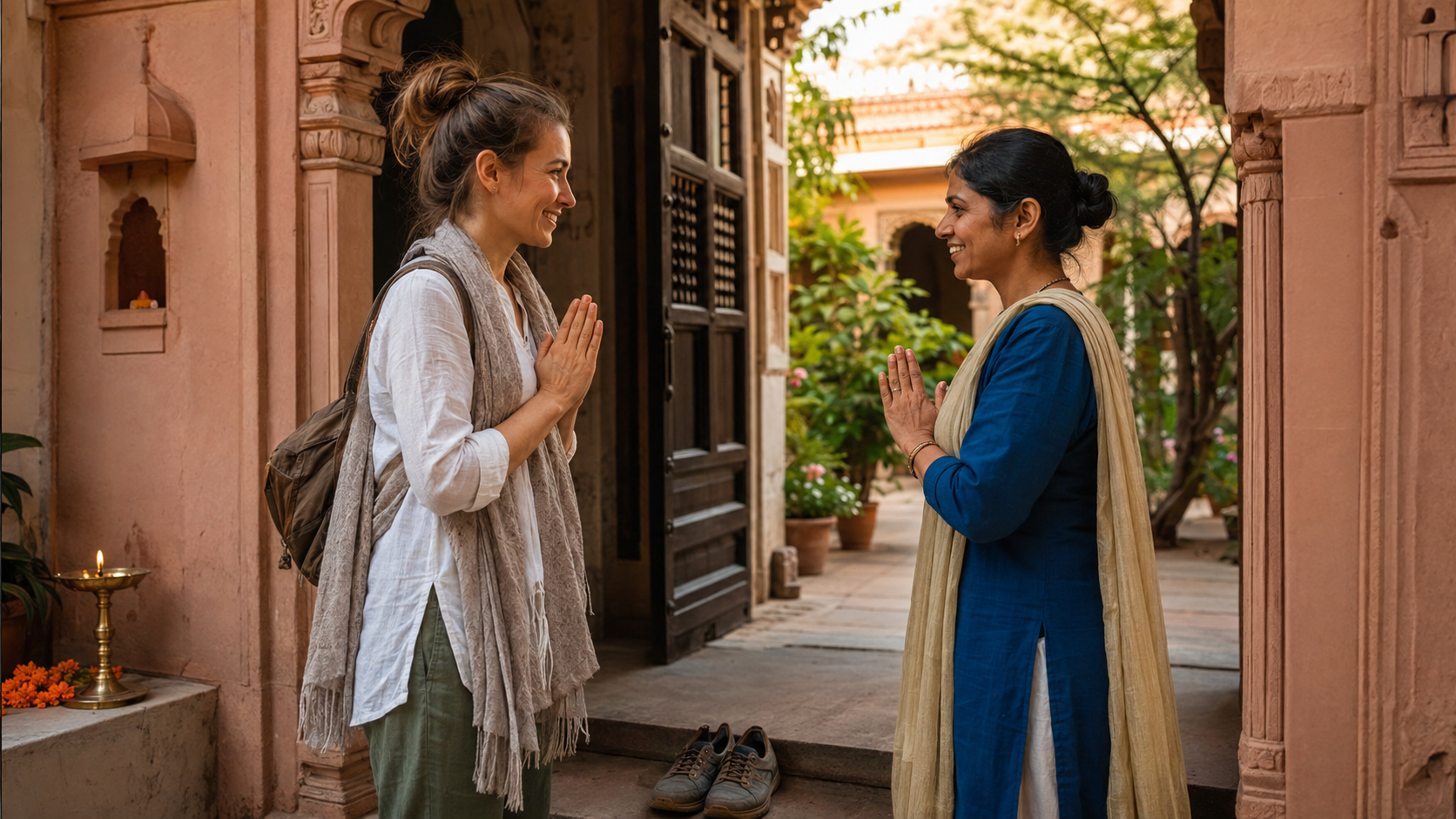
Namaste, usually accompanied by palms joined lightly in front of the chest, is widely understood and respectful. You may also hear namaskar, vanakkam, sat sri akaal, adaab and many other regional or religious greetings. You do not need to perform the “perfect” Indian greeting. A genuine smile and a polite hello work almost everywhere.
Handshakes are common in professional settings and cities, but some people may prefer not to shake hands, particularly with someone of another gender. Pause for a moment and allow the other person to lead. If they join their palms, return the gesture. If they offer a hand, shake it.
When speaking to someone older, a slightly more formal manner is appreciated. Sir and madam are used more frequently than many Western visitors expect. You may also hear unrelated elders called “auntie” or “uncle”. It is a familiar expression of respect, not a claim of family connection.
Conversation can become personal quickly
On a train journey, you may be asked within minutes where you are from, whether you are married, how many children you have or what you do for work. Questions about age, family and sometimes income may feel unusually direct. Often they are a way of locating you socially and finding a friendly thread of conversation rather than an attempt to invade your privacy.
You are still entitled to boundaries. A warm, vague answer followed by a question of your own usually moves the conversation along. “I work at a university. What about you?” is often all you need.
Try not to assume that every nod or sideways movement of the head means exactly “yes” or “no”. The familiar Indian head movement can express agreement, acknowledgement, politeness or simply “I am listening”. Context and spoken words matter more than trying to decode the gesture on its own.
What to wear in India
There is no universal Indian dress code. In large cities and established tourist areas, you will see everything from saris and kurta-pyjamas to jeans, business suits and contemporary fashion. The practical question is not whether visitors must wear Indian clothing. They do not. It is whether your clothing suits the setting.
For ordinary sightseeing, lightweight clothes that cover the shoulders and reach close to the knee are a comfortable, low-stress choice for any gender. They protect you from sun and mosquitoes as well as helping you move easily between streets, markets and religious sites. The UK government’s current India travel advice recommends respecting local dress and customs, particularly at religious sites and in rural areas.
Keep a thin scarf or shawl in your day bag. It can cover shoulders or the head when required, add warmth on an air-conditioned train and provide a little extra privacy in a crowded place. Beachwear belongs at the beach or hotel pool, not in nearby towns, cafés or places of worship.
If a site displays a dress code, follow it even when you have seen different advice elsewhere. Local instructions always take priority.
Religious-site etiquette
India’s sacred places are often among its most beautiful spaces: temple bells sounding at dawn, rose petals scattered on cool marble, incense drifting beneath a carved gateway. They are also living places of worship, not simply historic attractions.
The official Incredible India guidance advises visitors to dress appropriately and notes that shoes are customarily removed at certain places of worship. In practice, rules vary from one site to another. Look for signs, shoe counters and the behaviour of worshippers before entering.
Hindu and Jain temples
- Remove shoes wherever instructed. Socks may also need to come off.
- Dress modestly and keep voices low, particularly near the inner sanctuary.
- Some temples restrict entry to parts of the complex, and a small number do not admit non-Hindus. Never cross a barrier or argue with a local rule.
- Photography may be prohibited inside, especially near the main deity. Ask before lifting your camera.
- Some Jain temples prohibit leather items. Check the site’s rules before visiting.
- If you receive prasad, a blessed food offering, accept it respectfully with the right hand or both hands. You can watch the person ahead of you if you are unsure.
Sikh gurdwaras
Gurdwaras welcome visitors of all backgrounds. Remove your shoes, wash your hands and cover your head before entering. A proper scarf or the cloth provided at the entrance is preferable to treating the requirement casually. At Sri Harmandir Sahib, the Golden Temple in Amritsar, official tourism guidance specifically instructs visitors to deposit shoes and cover the head.
Inside the prayer hall, sit quietly and avoid pointing your feet towards the Guru Granth Sahib. Many gurdwaras serve langar, a free community meal open to everyone. Sit where directed, accept only what you can eat, and avoid wasting food. Volunteering to wash dishes or help serve can be a meaningful experience, but ask where assistance is needed rather than simply stepping into a working kitchen.
Mosques and dargahs
Remove shoes where required and wear clothing that covers shoulders and legs. Some sites ask women to cover their hair, while others do not, so carry a scarf and follow local guidance. Avoid walking directly in front of someone who is praying. Tourist entry may be limited during prayer times or in certain areas of the complex.
Buddhist monasteries and churches
Keep your voice low, silence your phone and avoid interrupting prayers or ceremonies. Do not touch statues, manuscripts, ritual objects or wall paintings. In a monastery, walk around sacred objects in the direction indicated by local custom and never step over a person, prayer text or ritual item.
At any place of worship, the safest rule is to follow signs and instructions without assuming that one sacred site works like another.
Hands, feet and everyday body language
The right hand is traditionally preferred for eating, offering money and passing objects, especially in homes, markets and religious settings. Using both hands can also communicate care and respect. This custom is less rigid in modern restaurants and professional spaces, so do not become anxious if you forget. Simply notice and adjust.
Feet are often regarded as the least clean part of the body. Avoid pointing the soles of your feet towards a person, shrine or sacred object. Do not step over food, books, people sitting on the floor or items used in worship. If you accidentally touch someone with your foot, a quick apology is appropriate.
The head can carry spiritual and personal significance, so avoid patting children or adults on the head unless you know them well. Public displays of affection also tend to be more restrained outside cosmopolitan or tourist settings. Holding hands is usually unremarkable, but passionate kissing in public may cause discomfort or attract attention.
Eating with your hands, accepting food and sharing a table
Eating with your hand is neither compulsory nor a performance. If cutlery is provided, use it. If a meal is traditionally eaten by hand and you would like to join in, wash first and use the fingertips of your right hand rather than the whole palm. Your host will usually be delighted to show you.
At a shared meal, use the serving utensils rather than a spoon that has touched your mouth. Ask before ordering food for the whole table. Vegetarianism may be connected to religion, family tradition or personal choice, and some households keep strictly vegetarian kitchens. Beef, pork, alcohol and eggs may each be sensitive in different communities. If you are bringing food to a home, check first.
Hospitality can be wonderfully persistent. A host may refill your plate several times because feeding a guest is a form of affection. If you have had enough, place a hand gently over your plate and thank them warmly. A blunt “no” can sound harsher than “It was delicious, but I truly cannot eat another bite.”
Never mock an unfamiliar dish, smell or way of eating. You can decline politely without turning someone’s everyday food into a spectacle.
When you are invited into an Indian home
A home invitation may become one of the memories that stays with you longest: tea appearing almost immediately, plates of snacks arriving from the kitchen, several generations drifting into the conversation. Arrive with openness and allow the visit to unfold at its own pace.
- Look at the doorway for a clue about shoes. If footwear is gathered outside, remove yours. When uncertain, ask.
- A small gift is thoughtful but not required. Sweets, fruit, flowers or something modest from your home region are usually safer than alcohol.
- Greet older family members first when introductions are made.
- Accept at least a little tea, water or food if you comfortably can. Hospitality is part of the welcome.
- Ask before photographing the home, family members or a religious shrine.
- Do not assume an invitation permits you to bring additional guests.
Indian ideas of time can be more flexible in social situations than in transport, business or formal bookings. A relaxed family dinner may begin later than its stated hour, but a train will not wait because you adopted “Indian time”. Be punctual yourself and allow your host to set the evening’s rhythm.
Photography: permission changes the picture
India can feel endlessly photographic: flower sellers threading orange marigolds, painted trucks, wedding processions, pilgrims on river steps. Yet a beautiful scene is also somebody’s work, worship, grief or private life.
Ask before taking a close portrait, particularly of children, religious figures, craftspeople and anyone in a vulnerable situation. A smile and a gesture towards the camera often communicate the question when language does not. Accept a refusal immediately and never photograph a person secretly after they have said no.
At protected monuments, the Archaeological Survey of India says general still photography is usually permitted, but tripods, artificial lighting and filming can require permission. Site-specific notices still take precedence. ASI’s visitor guidance also asks people to observe active customary traditions quietly and respectfully, without photography or loud behaviour.
Pause before posting as well as before shooting. Avoid captions that reduce people to poverty, exoticism or a joke. A respectful photograph should preserve someone’s dignity after you have left.
Bargaining, tips and money etiquette
Bargaining is normal in many bazaars, with rickshaw drivers who are not using a meter and at some tourist markets. It is not appropriate everywhere. Supermarkets, pharmacies, ticket counters, restaurants with printed menus and fixed-price craft shops generally have set prices.
Keep bargaining light. Ask the price, make a reasonable counteroffer and smile. If you cannot agree, walk away politely. Turning a small difference into an aggressive contest rarely improves your day, especially when that amount means far more to the seller than it does to you.
Tipping customs vary by place and type of service. Check whether a restaurant bill already includes a service charge, and keep small notes for porters, drivers, guides and hotel staff when you want to recognise good service. A tip should be a thank-you, not a way to ignore poor treatment or avoid agreeing a price in advance.
Festivals, ceremonies and crowded public spaces
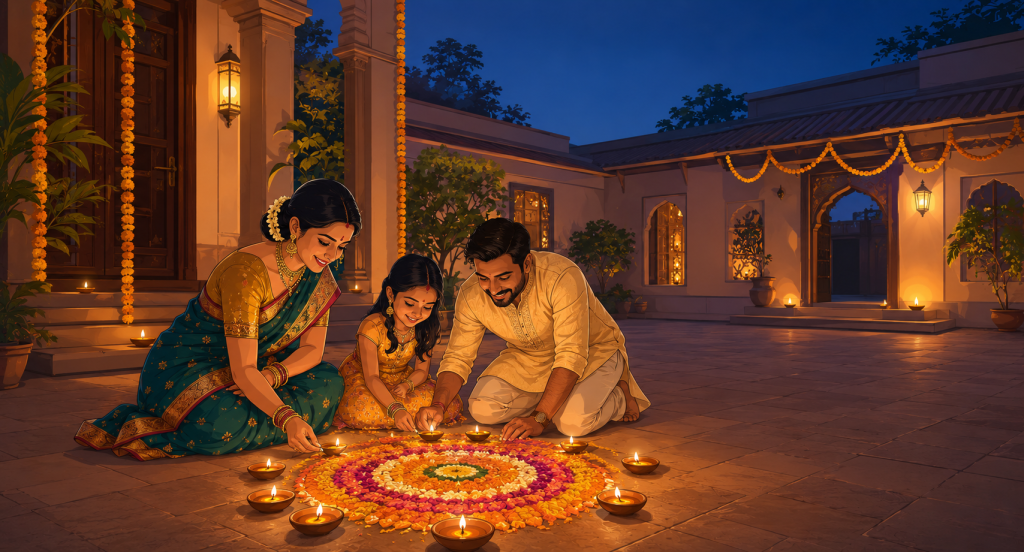
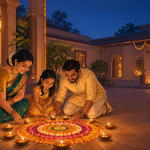
Being welcomed into Holi, Diwali, Eid, Durga Puja, Onam, a wedding or a village celebration can be extraordinary. Join with the understanding that you are entering an event with religious, family or community meaning.
Ask before participating in a ritual. During Holi, do not apply colour to anyone without consent. At a funeral procession or cremation ground, put the camera away unless you have clear permission. During a wedding, follow the family’s lead rather than moving into ceremonial spaces for a better photograph.
Crowds may move differently from the orderly queues you know at home. Stay patient, protect personal space without pushing, and avoid lecturing people around you. Calmness is both more respectful and more effective.
Alcohol, smoking and local sensitivities
Attitudes and laws concerning alcohol vary considerably between Indian states and communities. Some states prohibit or tightly restrict it, while many religious towns and sacred areas are dry. Drink only where it is legal and appropriate, and avoid arriving at a home with alcohol unless you know it will be welcome.
Smoke only in permitted areas. Never light a cigarette inside a religious complex, near a shrine or in someone’s home without asking. Loud drunken behaviour is likely to offend and can turn a manageable situation into an unsafe one.
Travel without turning people into attractions
Respect goes beyond table manners and temple rules. Buy crafts directly from makers where possible, pay fairly, reduce waste and avoid handing out sweets, pens or money to children for photographs. Do not enter fields, workshops or homes simply because the doorway is open.
The Ministry of Tourism’s Travel for LiFE programme encourages more sustainable behaviour by visitors and tourism businesses. At ground level, that means small choices: refill water where it is safe to do so, carry your rubbish out of fragile places, choose local businesses and leave monuments exactly as you found them.
When people share a story, skill or sacred space with you, receive it as generosity rather than something your journey was entitled to collect.
What if you make a cultural mistake?
You probably will, and that is all right. You may forget to remove your shoes, offer something with the wrong hand or stand where you should not. Most people recognise the difference between uncertainty and disrespect.
Do not launch into a long defence. Say sorry, correct the mistake and move on. A useful phrase is, “I’m sorry, I didn’t know. Please show me what I should do.” It replaces embarrassment with curiosity and gives the person beside you an easy way to help.
A quick India etiquette checklist
| Situation | Good default |
|---|---|
| Greeting someone | Smile, say hello or namaste, and let them lead on handshakes |
| Visiting a sacred place | Dress modestly, remove shoes when asked and check photography rules |
| Passing food or money | Use your right hand or both hands when practical |
| Eating in a home | Follow your host, respect dietary practices and praise food sincerely |
| Taking a portrait | Ask first and accept no without pressure |
| Bargaining | Keep it friendly and recognise fixed-price settings |
| Making a mistake | Apologise briefly, adjust and continue with good humour |
Frequently asked questions about Indian etiquette
Is it appropriate for visitors to say namaste?
Yes. Namaste is widely understood and is a polite greeting, but it is not the only greeting used across India. A simple hello is equally acceptable. Follow the other person’s lead and do not feel that you must perform a gesture to appear culturally aware.
Do tourists need to wear traditional Indian clothing?
No. Comfortable Western clothing is fine. Choose modest, lightweight clothes for rural areas and places of worship, and carry a scarf for sites that require the shoulders or head to be covered.
Must I remove my shoes at every temple?
Shoes are removed at many temples and other places of worship, but the exact boundary differs. Look for shoe racks, signs and the behaviour of worshippers. Ask an attendant if it is not clear.
Is eating with the left hand rude in India?
The right hand is traditionally used for eating and passing food, especially in homes and religious settings. Cutlery is widely used, and most people will understand an innocent mistake. Use your right hand when practical without becoming self-conscious.
Can I photograph people and ceremonies?
Ask before taking a close portrait or photographing a ceremony. Religious sites, monuments and festivals may impose additional restrictions. A person’s consent and the instructions at the site matter more than whether photography is technically possible.
The etiquette that matters most
You do not need to arrive in India already knowing the correct hand for every gesture or the right word in every language. You need only recognise that the country is someone else’s home before it is your destination.
Move slowly enough to notice the shoes at the doorway. Ask before taking the photograph. Receive food with gratitude. Let a local person correct you without feeling diminished. These small acts will not make you invisible as a visitor, nor should they. They will make you a welcome one.