Now Reading: Rishikesh and Haridwar: A Spiritual Journey Along the Ganges
-
01
Rishikesh and Haridwar: A Spiritual Journey Along the Ganges

Follow the Ganga from Haridwar's powerful pilgrimage rituals to Rishikesh's ashrams and river quiet with this practical five-day spiritual itinerary.
Before sunrise, Haridwar is already awake. Bare feet move over cool stone, bells carry across the half-light and the Ganga slips past Har Ki Pauri in a fast, pewter-grey current. A woman cups the river in both hands and lifts it towards the paling sky. Beside her, a family murmurs a prayer while a tea seller sends small clouds of cardamom and steam into the morning air.
Twenty-five kilometres upstream, Rishikesh meets the same river differently. Forested hills gather around the water. Yoga mats appear on terraces. Saffron-robed pilgrims share lanes with travellers carrying notebooks, and the day can begin with either a temple bell or the soft instruction to breathe.
Visiting Rishikesh and Haridwar together reveals two distinct expressions of spiritual India. Haridwar is collective, ancient and intensely devotional. Rishikesh is gentler, more spacious and often more inward-looking. One places you among thousands of pilgrims; the other gives you room to sit beside the river and listen.
This guide follows a realistic five-day journey from Haridwar to Rishikesh, with a shorter three-day version for travellers with limited time. It is designed for curious first-time visitors, including those who do not follow Hinduism but want to approach these sacred places with respect.
Rishikesh and Haridwar at a glance
- Ideal time: Five days and four nights
- Minimum useful time: Three days and two nights
- Best order from Delhi: Haridwar first, then Rishikesh
- Distance between them: About 25 kilometres
- Best months: February to April and September to November
- Essential experiences: Dawn at Har Ki Pauri, evening Ganga aarti, a riverside walk in Rishikesh and an unhurried yoga or meditation session
Why Rishikesh and Haridwar belong in the same journey
Haridwar stands where the Ganga reaches the plains after descending from the Himalayas. Its name is often interpreted as the gateway to the divine, and for generations it has been a place of arrival, purification and departure towards the sacred mountain shrines of Uttarakhand.
Rishikesh lies closer to the foothills, where the river is framed by forest and steep slopes. It is a pilgrimage town too, but its ashrams, yoga schools and meditation centres have given it a global spiritual identity. The official tourism portal describes it as a gateway to the Char Dham pilgrimage and a major centre for yoga and meditation.
Together, the two cities form a natural extension of any wider North India journey. You can travel from Delhi’s noise to Haridwar’s concentrated devotion, then follow the river upstream into Rishikesh’s calmer rhythm. The route is short in distance but surprisingly rich in emotional contrast.
| Haridwar | Rishikesh | |
|---|---|---|
| Atmosphere | Busy, devotional and deeply rooted in pilgrimage | Reflective, international and shaped by ashram life |
| Defining experience | Ganga aarti at Har Ki Pauri | Yoga, meditation and slow time beside the river |
| Best for | Witnessing living Hindu pilgrimage traditions | Personal reflection, wellness and riverside walks |
| Suggested stay | Two nights | Two or three nights |
| Travel pace | Early starts and crowded sacred spaces | Slower mornings and flexible days |
A five-day Rishikesh and Haridwar itinerary
Day 1: Arrive in Haridwar and meet the Ganga
Try to reach Haridwar by early afternoon. After checking in, resist the urge to begin with a long list of temples. Walk instead towards Har Ki Pauri through the old bazaar, allowing the city to introduce itself gradually.
The lanes are dense with brass vessels, vermilion powder, marigold garlands and little leaf bowls prepared for river offerings. Cycle rickshaws ring their bells through gaps that barely seem wide enough. Sweet shops display coils of jalebi beside steel trays of milk cake. Cows stand with complete confidence in the middle of the flow.
Har Ki Pauri is Haridwar’s spiritual centre. Its name is commonly understood as the footsteps of Lord Vishnu, and the ghat receives pilgrims from across India. Come before the evening aarti begins, ideally 60 to 90 minutes before sunset during busy periods. This gives you time to understand the layout, find a safe place to sit and absorb the gathering mood.
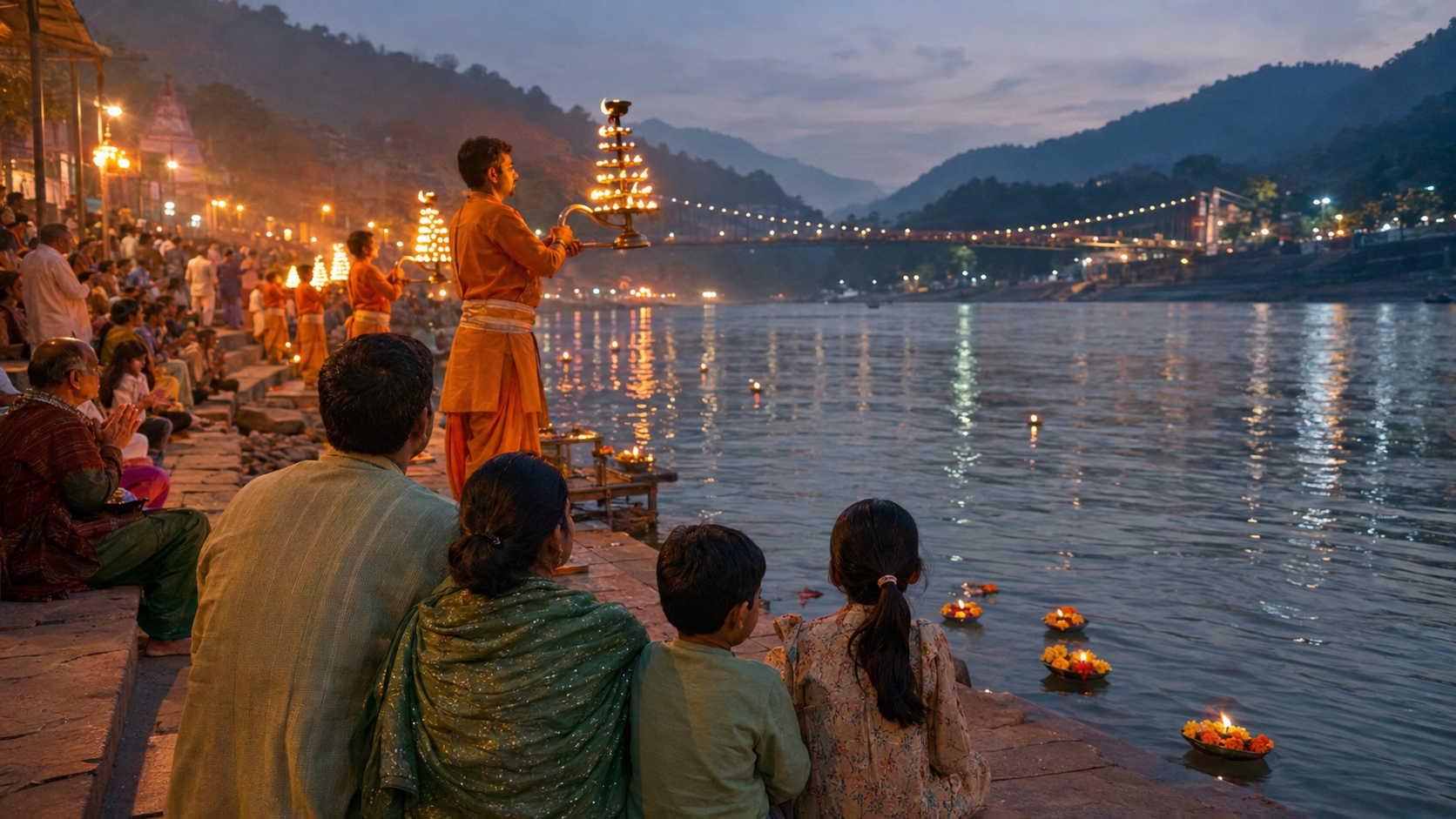
As daylight fades, priests lift large lamps above the river. Bells, drums and chanting rise together. Hundreds of flames flicker in the moving water. It is visually magnificent, but the power of the moment lies in the people around you: grandparents showing children how to fold their hands, pilgrims whispering the names of loved ones and families carrying prayers from places far away.
You do not need to copy every gesture. Sit quietly, stand when asked, avoid blocking worshippers for photographs and let the ritual unfold without making yourself its centre.
Day 2: Haridwar at dawn and temples above the city
Return to Har Ki Pauri around sunrise. The ghat feels more intimate now. Priests sit beneath umbrellas, bathers hold chains fixed along the steps and the first sunlight turns the river from silver to green. The current can be much stronger than it appears, particularly during the monsoon. Use only recognised bathing areas, follow local warnings and never enter the water simply because others are doing so.
If you want to take part without bathing, touch a little water to your forehead or sit on the steps. Participation does not need to be dramatic to be sincere.
After a breakfast of aloo puri, kachori with spiced potato curry or a simple cup of chai, visit Mansa Devi Temple on Bilwa Parvat. You can walk uphill or take the ropeway. The temple is devoted to the wish-fulfilling goddess Mansa Devi, and the higher ground gives a useful sense of Haridwar’s geography, with the river spreading towards the plains.
Travellers with the energy for a second hill temple can continue to Chandi Devi Temple on Neel Parvat, also reached by a climb or ropeway. Doing both in one day is possible, but queues, heat and festival crowds can turn it into a tiring exercise. Choosing one temple and giving it your attention is often more rewarding than rushing through both.
Spend the late afternoon resting or wandering the market around Bara Bazaar. Return to the river at a quieter ghat, rather than repeating the previous evening from exactly the same viewpoint. Haridwar becomes easier to understand when you see devotion in its ordinary forms: a flower placed in the current, a priest tying a thread around a wrist, a family sharing prasad on the steps.
Day 3: Travel upstream to Rishikesh
Leave Haridwar after breakfast. The journey to Rishikesh usually takes between 45 and 90 minutes by road, depending on traffic, pilgrimage season and where you are staying. Local buses are cheapest, shared vehicles are convenient for light luggage and a private taxi is easiest for families or travellers carrying larger bags.
For a spiritual visit, stay around Swarg Ashram, Ram Jhula or Muni Ki Reti. Tapovan has a wider choice of hostels, yoga schools and cafés, but it can feel busier and more commercial. The best base depends on whether you want quiet access to ashrams or a livelier traveller neighbourhood.
Begin with a slow walk along the river. Cross at Ram Jhula or Janki Setu, follow the eastern bank through the ashram area and pause where the steps descend towards the Ganga. Monkeys patrol several bridge and temple areas, so keep food inside your bag and do not encourage them by feeding or teasing them.
Bridge update for 2026: The original Lakshman Jhula remains closed to pedestrians. The new Bajrang Setu beside it has been completed, with separate arrangements being introduced for access to its glass walkways. Operating rules and charges may change, so check locally rather than planning your day around a fixed online timetable.
Choose one Rishikesh aarti for the evening. Parmarth Niketan offers an accessible and beautifully organised ceremony near the river, while Triveni Ghat often feels more closely woven into the daily life of the town. Arrive early, especially at weekends and during festival periods.
Day 4: Yoga, the Beatles Ashram and a quieter riverbank
Rishikesh deserves at least one morning without an alarm set for sightseeing. Join a beginner-friendly yoga class, attend meditation at an established ashram or simply sit beside the river before breakfast. If you are new to yoga, choose a drop-in class that welcomes beginners rather than an intensive teacher-training school. A good teacher will ask about injuries and offer adjustments without making the experience competitive.
Later, walk to Chaurasi Kutia, better known as the Beatles Ashram, in the Swarg Ashram area. Maharishi Mahesh Yogi’s former retreat became internationally famous after the Beatles stayed here in 1968. Today its meditation cells, forest paths and later murals create a strangely beautiful mixture of spiritual history, creative mythology and slow reclamation by nature.
Give yourself time to wander. The site is not only for Beatles fans. Its dome-shaped meditation huts and quiet corners reveal something about the period when Indian spiritual traditions began reshaping Western music and popular culture. Opening hours and admission charges can change, so confirm them locally before setting out.
Spend the rest of the afternoon without an agenda. Eat a vegetarian thali, read beside the river or explore the ashram lanes between Ram Jhula and Swarg Ashram. Rishikesh can become surprisingly tiring when treated as a collection of attractions. Its real gift is the permission to slow down.
Day 5: Choose your final pilgrimage
Use your last day for one experience that matches the reason you came.
- For contemplation: Visit Vashistha Cave, north of Rishikesh, where a simple cave beside the river offers a quiet meditation space. Go respectfully, keep conversation low and avoid treating people in meditation as part of the scenery.
- For devotion: Travel to Neelkanth Mahadev Temple in the forested hills above Rishikesh. The road can be slow and winding, and pilgrimage days become crowded, so leave early.
- For a gentle final morning: Stay in town. Attend a second yoga class, visit Bharat Mandir or sit at a quiet ghat with tea before departure.
If you are returning to Delhi by train, Haridwar often has the broader range of services, while Rishikesh and Yog Nagari Rishikesh stations serve selected routes. Check the departure station carefully when booking because the two Rishikesh stations are not the same place.
A shorter three-day itinerary
Three days is enough to experience both cities, but only if you accept that you will be sampling them rather than fully settling into either.
- Day 1: Arrive in Haridwar, walk through the old bazaar and attend Ganga aarti at Har Ki Pauri.
- Day 2: Visit Har Ki Pauri at sunrise, have breakfast, then travel to Rishikesh. Walk around Ram Jhula and Swarg Ashram before attending aarti at Parmarth Niketan or Triveni Ghat.
- Day 3: Take an early yoga or meditation class, then choose either the Beatles Ashram or a slow riverside walk before departure.
Do not add both Mansa Devi and Chandi Devi, a rafting trip, the Beatles Ashram and an out-of-town temple to this short route. The result would be transport rather than travel.
Which Ganga aarti should you attend?
If possible, attend one in each city. The ceremonies share lamps, prayers and devotion to the river, but their emotional scale is different.
Har Ki Pauri, Haridwar
This is the larger and more intense experience. The crowds can be substantial, and the atmosphere has the force of collective pilgrimage. Choose it if you want to witness one of North India’s defining devotional rituals.
Parmarth Niketan, Rishikesh
This ceremony is popular with both Indian and international visitors. It is visually graceful and relatively easy for a first-time visitor to follow. Seating fills early in high season.
Triveni Ghat, Rishikesh
Triveni Ghat is a strong choice if you want a town-centred ceremony with a local devotional atmosphere. The riverfront becomes busy around dusk, so arrive early enough to find a place without pushing through worshippers.
Aarti times move with sunset and can vary by season, venue and festival calendar. Ask your accommodation on the day and arrive well ahead of the stated start.
Eating in Haridwar and Rishikesh
Food in both cities is closely shaped by their sacred character. Rishikesh is officially vegetarian and alcohol-free, and Haridwar’s pilgrimage areas are strongly vegetarian. Treat this as part of the journey rather than a restriction.
In Haridwar, mornings are built for kachori-sabzi, aloo puri, jalebi and hot milk. Portions can be rich, so share a plate before ordering more. Look for busy, clean stalls where food is cooked in front of you and turns over quickly.
Rishikesh offers two overlapping food cultures. Around the ashrams you will find simple thalis, dal, rice, roti and sattvic meals prepared without onion or garlic. Tapovan has cafés serving everything from porridge and hummus to excellent Indian breakfasts. Try to include at least one Garhwali meal, with dishes such as kafuli, chainsoo or mandua roti when available.
Drink filtered or sealed water, wash or peel raw fruit and be cautious with chutneys that may have been diluted with untreated water. A crowded stall is often a better sign than an empty one, but your own judgement still matters.
Where to stay
In Haridwar
- Near Har Ki Pauri: Best for dawn visits and aarti, but expect crowds, bells and narrow vehicle access.
- Near the railway station: Practical for a late arrival or early departure, with easy access to transport and food.
- Along quieter stretches of the river: Better for families and light sleepers, though you will need a rickshaw to reach the main ghat.
In Rishikesh
- Swarg Ashram and Ram Jhula: Best for ashrams, walking and an older spiritual atmosphere.
- Tapovan: Best for hostels, cafés, drop-in yoga and a social traveller scene.
- Muni Ki Reti: A useful middle ground with easier road access and proximity to the river.
Read recent reviews for noise as carefully as you read them for cleanliness. Temple bells, wedding music, road traffic and construction can all begin early. A river view is lovely, but a quiet room may give you more peace.
Best time to visit Rishikesh and Haridwar
February to April brings pleasant mornings, warming afternoons and good conditions for walking. September to November is another excellent period, with clearer post-monsoon landscapes and comfortable temperatures. These are also popular months, so book ahead around weekends and festivals.
May and June can be fiercely hot in Haridwar. Plan outdoor visits for early morning and late afternoon, carry water and leave room for a midday rest.
July and August are monsoon months. Heavy rain, powerful river currents, slippery steps, road disruption and landslides in the wider hill region can affect plans. Never cross barriers or enter the river when warnings are in place.
December and January offer quieter days and cool, sometimes cold mornings. Pack layers, particularly if your accommodation has limited heating.
Major pilgrimage periods can transform both cities. Kumbh and Ardh Kumbh years, Kanwar Yatra, religious festivals and long weekends may bring road controls, extreme crowding and limited rooms. Check the Uttarakhand calendar before booking a supposedly simple two-city break.
How to get there and travel between the cities
From Delhi
Haridwar is the easiest first stop for most travellers. Direct trains connect it with Delhi and other major Indian cities. Road travel commonly takes five to seven hours, but congestion can add considerably more time during weekends and pilgrimage seasons.
Rishikesh also has rail access, including services through Yog Nagari Rishikesh, but schedules are more limited. If a convenient direct service is unavailable, travel to Haridwar and continue by bus, shared vehicle or taxi.
By air
Jolly Grant Airport near Dehradun is the closest airport to both places and is particularly convenient for Rishikesh. Prepaid or app-based taxis may be available, but confirm the collection point and fare before leaving the terminal.
Between Haridwar and Rishikesh
Local buses are frequent and inexpensive. Shared auto-rickshaws and larger shared vehicles operate on parts of the route, while a taxi provides door-to-door convenience. Allow extra time on Fridays, Sundays, festival dates and during the Kanwar pilgrimage.
How to travel respectfully
Neither city is a spiritual theme park. The ghats are places where people pray, bathe, remember the dead, celebrate family milestones and fulfil lifelong vows. A little awareness changes the quality of your visit.
- Dress modestly around temples, ashrams and ghats. Cover shoulders and knees, and carry a light scarf.
- Remove shoes where requested and avoid touching shrines or ritual objects unless invited.
- Ask before photographing priests, sadhus, bathers or families performing ceremonies.
- Do not photograph cremation rituals or private acts of mourning.
- Decline persistent priestly services politely but clearly if you do not want them. Agree on any donation or fee before a personal ritual begins.
- Choose plastic-free offerings where possible and never throw packaging into the river.
- Do not feed monkeys. Keep glasses, phones and loose food secure near bridge areas.
- Avoid public displays of alcohol or intoxication. Rishikesh is an alcohol-free sacred city.
- Use designated changing areas and be sensitive when people are bathing.
Safety beside the Ganga
The river is beautiful, cold and far more powerful than it may look from the steps. Currents change with rainfall and water releases upstream.
- Bathe only at recognised ghats and use the safety chains where provided.
- Keep children within arm’s reach near steps and crowded riverfronts.
- Do not stand on wet ledges for photographs.
- Never enter the water after dark, during high flow or where warning signs are posted.
- Wear sandals with grip. Smooth ghat steps become slippery when wet.
- Keep valuables minimal during aarti. Crowds become tightly packed when people leave.
Women travelling alone will generally find both cities accustomed to pilgrims and international visitors, but ordinary precautions still apply. Choose a well-reviewed central stay, avoid isolated river paths after dark and arrange trusted transport for very early departures.
What to pack
- Light, modest clothing and an extra layer for cool mornings
- A scarf for temple visits
- Slip-on shoes that are easy to remove
- Sandals with good grip for the ghats
- A refillable water bottle and water-purification option
- Sun protection and mosquito repellent
- A compact rain jacket in monsoon and shoulder seasons
- A small dry bag or waterproof phone pouch
- Cash in small denominations for rickshaws, offerings and simple cafés
Frequently asked questions
Are Rishikesh and Haridwar the same place?
No. They are separate cities in Uttarakhand, roughly 25 kilometres apart. Haridwar lies on the plains and is a major Hindu pilgrimage centre. Rishikesh sits closer to the Himalayan foothills and is known for temples, ashrams, yoga and meditation.
Is Haridwar or Rishikesh better for a first visit?
Haridwar offers the more powerful pilgrimage experience, while Rishikesh is easier for many international travellers to settle into. Visiting both is ideal because their differences deepen the journey.
How many days do I need?
Allow five days for a satisfying journey, with two nights in Haridwar and two or three in Rishikesh. Three days is the minimum if you want to experience both without spending the entire trip in transit.
Can non-Hindus attend Ganga aarti?
Yes. Visitors of all backgrounds can attend respectfully. You are not required to participate in gestures or make a donation. Dress modestly, avoid obstructive photography and follow instructions from organisers.
Can I drink alcohol in Rishikesh?
Rishikesh is officially an alcohol-free and vegetarian city. Respect its sacred character and do not bring or consume alcohol there.
Is it safe to swim in the Ganga?
Do not treat the Ganga as an ordinary swimming river. The current can be dangerously strong and the water is cold. If you wish to bathe, use a recognised ghat, hold the fixed chains where provided and obey all local warnings.
Is Lakshman Jhula open?
The original Lakshman Jhula remains closed to pedestrians. Bajrang Setu, the new bridge beside it, has been completed, but access arrangements for its glass walkway are newly introduced and may change. Confirm the situation locally.
The journey the river leaves with you
It is easy to remember Rishikesh and Haridwar as a sequence of images: lamps multiplied in black water, wet stone beneath bare feet, monkeys on bridge cables, a yoga hall open to the morning breeze. Yet the journey’s deeper impression comes from watching the same river hold so many meanings.
In Haridwar, the Ganga gathers people together. Faith is public, physical and carried by the crowd. In Rishikesh, the river seems to create space around each person. You begin to notice your breathing, the hills and the long quiet between bells.
Go with curiosity rather than expectation. Let Haridwar be intense. Let Rishikesh be slow. Follow the river upstream, and somewhere between the lamps and the morning mist, the journey may become more personal than you planned.
Planning a wider first visit? Start with our India Travel Guide for practical advice on routes, seasons, transport and travelling respectfully across the country.